
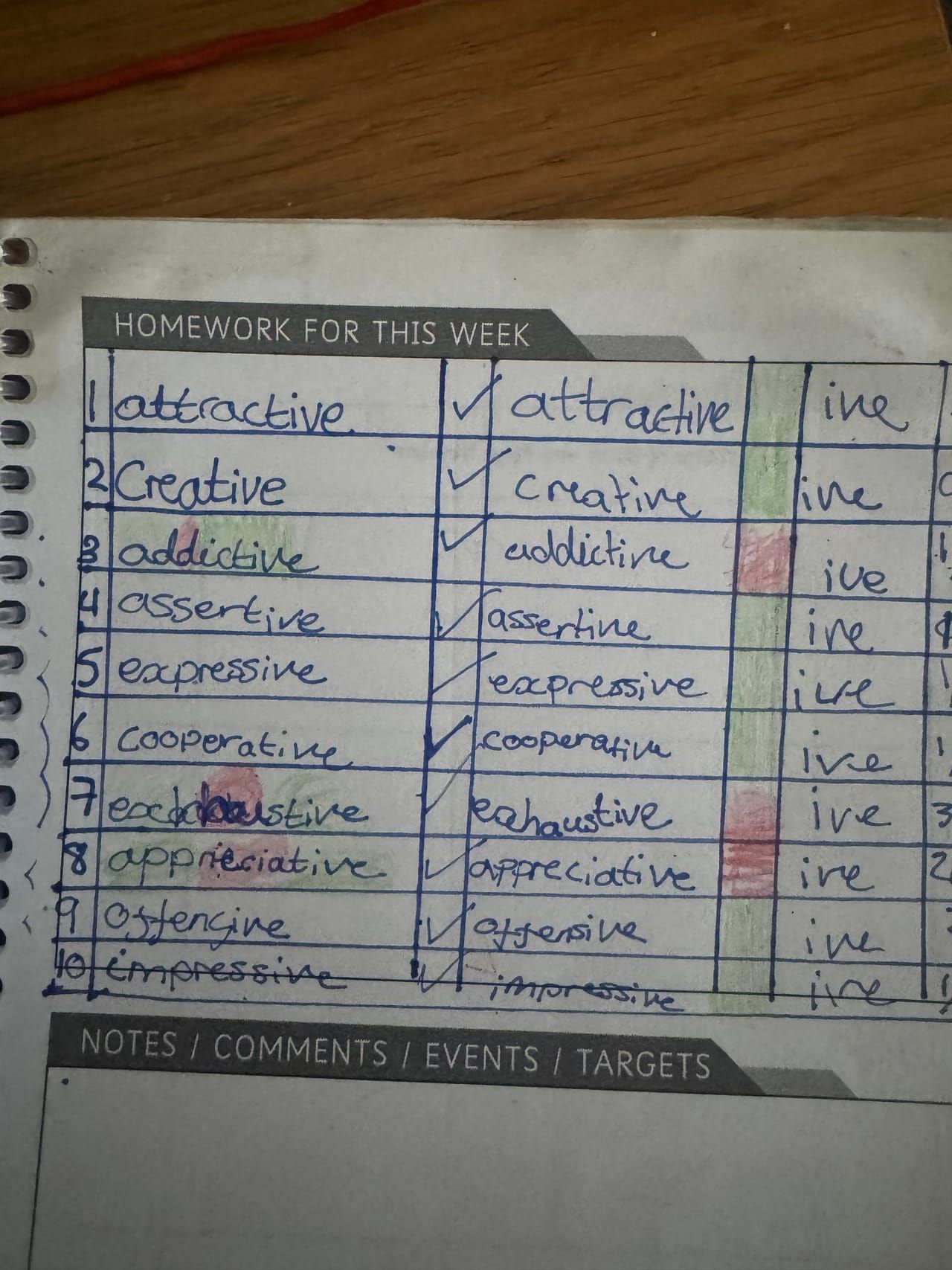
Term is ending, and your child's spelling log book has just come home for the last time this year. Before it disappears into a drawer until September, it is worth a second look.
Every week my son brings home ten spellings. Here is one week's list, straight from that log book.
attractive, creative, addictive, assertive, expressive, cooperative, exhaustive, appreciative, offensive, impressive.
Read it the way I first did and it is ten words to get through before the test. Ten separate things to memorise.
Now look at the end of each one. Every single word finishes with -ive. It is not ten words. It is one pattern, dressed up ten different ways. The school did not set a random list. They set the -ive suffix, and they set it on purpose.
That changes how you practise. You are not drilling ten spellings. You are teaching one rule and showing your child ten places it turns up.
But here is the part I nearly missed, and it is the important bit.
The -ive ending is the easy part. It is the same every time. Where my son actually tripped was the letter just before it. Look at number nine. He wrote offencive first, with a c, then corrected it to offensive. On another line the middle of exhaustive gave him trouble long before he got anywhere near the ending.
That is the real pattern, and it is not "-ive" at all. It is the consonant sitting in front of it. Expressive and impressive take a double s. Offensive takes a single one. Attractive and addictive take a ct. The suffix sounds identical every time. The spelling underneath it does not. That is where the marks are won and lost.
And this is why testing spellings at home the usual way misses so much. You read the word out, your child spells it back, you check the sheet, tick. Right on the night is a tick and you move on. You never see that they hesitated on the s, or that they would have written offencive if they were not concentrating. The pattern in the mistakes stays invisible.
That log book is the most useful thing in your child's bag right now. It holds a whole term of spellings, every pattern the class covered, in one place. And in a week it will be at the bottom of a drawer.
So before it vanishes, do this.
- Open the log book and photograph the pages.
- Spelling.Live reads them, captures the words and the mistakes, and finds the patterns behind them.
- Over the holidays your child practises those patterns in a few short goes, with games and spaced repetition, aimed at the bits they have not locked in.
No lists to type. No words to hunt down. The log book does the work.
Six weeks off is long enough to forget a year of spellings. Ten minutes here and there over the holidays holds the ground your child gained, so they start September sharp instead of rusty.
Ten words, one pattern. Snap the log book before it goes in the drawer, and let the app do the reading.