
Year 3 Spelling Words
In Year 3, children typically work on prefixes and suffixes, the -le ending, plurals and the most common homophones. Below are 41 words commonly taught at this level, grouped by the pattern each one practises - so your child learns the rule, not just the list.
The Australian Curriculum sets out the spelling knowledge expected at each year level but does not publish a single word list, and schools choose their own. These are words commonly taught at this year level, grouped by the spelling pattern they practise.
Year 3 words by spelling pattern
Prefixes and suffixes
Word parts added to a base word: un-, re-, -ful, -ly, -ness.
- unhappy
- redo
- helpful
- careful
- useful
- happily
- quickly
- kindness
- sadness
The -le ending
Many words end in a consonant plus -le.
- table
- little
- apple
- middle
- puzzle
- bottle
- simple
- circle
Plurals
-s, -es, and y changing to i: baby → babies.
- boxes
- wishes
- benches
- babies
- cities
- leaves
- knives
- children
Homophones
Words that sound the same but are spelled differently.
- their
- there
- they're
- to
- too
- two
- hear
- here
- where
- wear
-dge and -ge
The /j/ sound at the end of a word.
- bridge
- badge
- edge
- large
- change
- huge
Year 3 and NAPLAN
Year 3 is a NAPLAN year. The Conventions of Language test, sat by students in Years 3, 5, 7 and 9, includes spelling alongside grammar and punctuation. The best preparation isn't cramming lists: it's short, regular practice that brings tricky words back until they stick, and understanding the patterns behind them.
How to practise at home
- Little and often. Five to ten minutes a day works better than one long session before the test.
- Teach the pattern. If your child can spell unhappy, show them the other words in its group.
- Write, don't only type. Spelling tests are written by hand, so some practice should be too.
- Bring missed words back. Revisit words they got wrong a few days later, not just the next day.
Australian spelling follows British forms (colour, favourite, organise), and Spelling.Live reads words aloud in an Australian voice when your child is set to Australian English.
Practise your child's own Year 3 list on Spelling.Live
Type in, or photograph, the list your child's school sends home and Spelling.Live turns it into short daily practice: choosing, typing, saying and writing each word, with handwriting checked and missed words brought back until they stick. It names the spelling pattern behind each mistake, so you can see what to work on.
When you add your child, choose 🇦🇺 Australian English and Year 3 as their school year.
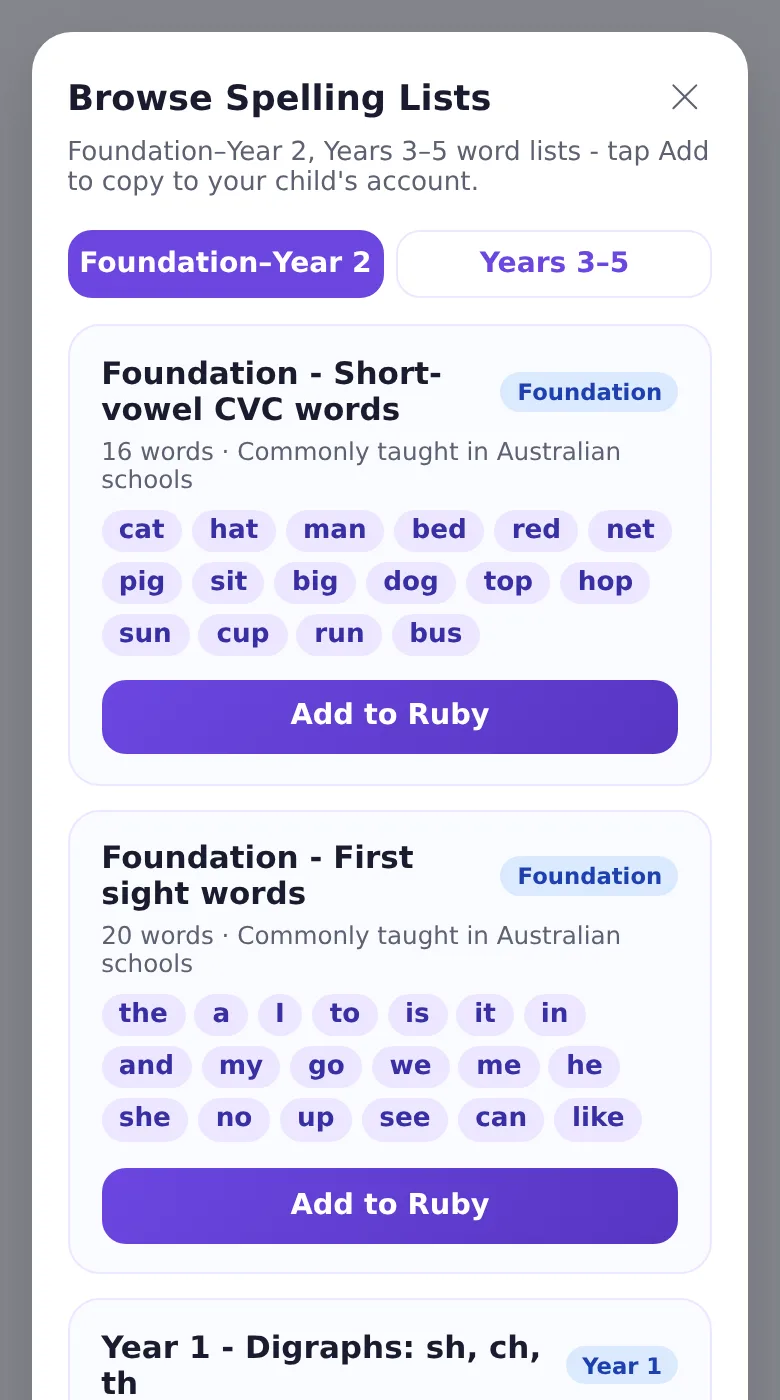
No list from school yet? Every list on this page is ready-made in the app: open Browse Spelling Lists and add one in a tap, or let Spelling.Live choose the list for their year level when you sign up.
Your school's own list, in Australian English. Free to start, no card needed.
Start practising freeMore Australia spelling lists: Foundation · Year 1 · Year 2 · Year 4 · Year 5 Spelling.Live for Australia families and schools →
Common questions
What spelling words should a Year 3 child know?
There's no single official list. In Year 3 (ages 8–9), children typically work on prefixes and suffixes, the -le ending, plurals and the most common homophones. The words on this page are common examples; your child's school list comes from the Australian Curriculum and their own spelling programs.
How many spelling words a week in Year 3?
Most schools send home between 5 and 15 words a week. A few minutes of practice each day, with missed words revisited later in the week, works better than learning them all the night before.
Can I practise my child's own Year 3 list?
Yes. Spelling.Live lets you type in or photograph the list your child's school sends home, in Australian English, and turns it into daily practice with handwriting checked.
Is spelling tested in Year 3 NAPLAN?
Yes. NAPLAN's Conventions of Language test, sat in Years 3, 5, 7 and 9, includes spelling as well as grammar and punctuation.
Are these Year 3 spelling lists ready-made in the app?
Yes. Every list on this page is a ready-made list in Spelling.Live. Set your child to Australian English, open Browse Spelling Lists and add one in a tap, with no typing needed.