
Drafted with AI assistance and reviewed, fact-checked and edited by hand before publishing - see our AI transparency page for how we use AI across the app.
Most spelling apps bolt a game onto the side: get through your flashcards, then here's a generic arcade level as a reward, unconnected to what you were just practising. Spelling.Live takes a different approach. Every game is powered by the child's actual word list - the same tricky words from their spelling list turn into fast, colourful arcade play instead of a separate distraction.
The same words, a different kind of practice
Pop the right letter-balloon before it drifts away in Balloon Pop (or Spell Buzz, the faster fluent-band version). Hunt hidden words in a letter grid in Word Search. Snap letters together against the clock in Word Builder. Crack a combination lock one letter at a time in Word Lock, or fill in a grid in Crossword. And then there are the three arcade centrepieces this post is really about: Letter Climb, Letter Maze and Boggle. Different mechanics, same underlying goal: every letter a child taps, drags or types is a real word from their own list, not a stock word bank.
That matters because recognising a word quickly, under a bit of time pressure, is a genuinely different skill from writing it out slowly and carefully - and both are worth practising. It's also why we keep the two separate in the progress report: practice and dictation results count toward your child's accuracy trend, while game activity is recorded and visible to you, but doesn't get mixed into that report. A wrong guess while chasing a balloon, or while fleeing a ghost, shouldn't look the same as a genuine spelling miss.
Letter Climb: ladders, barrels, and the letter you keep hesitating over
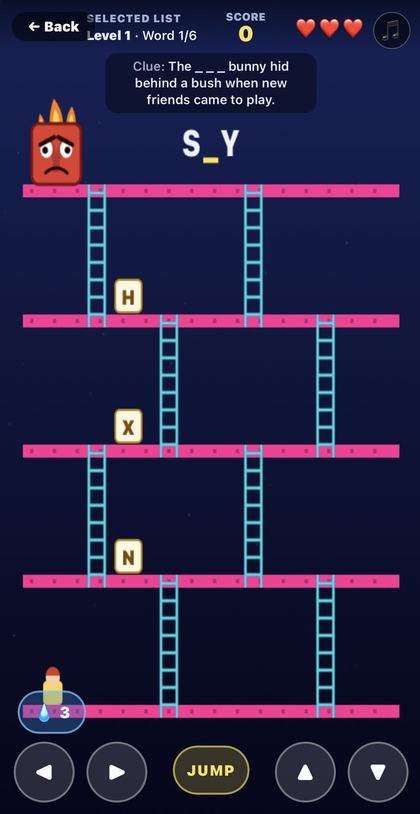
Letter Climb is Spelling.Live's Donkey-Kong-style platformer, and it plays like one: girders, ladders, barrels rolling down at you, three lives shown as hearts. The twist is what you're climbing for. The word appears at the top with some letters blanked out - S_Y, say - and letter tiles are scattered across the girders below: the correct letter mixed in among decoys. The child has to climb toward the right tile while dodging the barrels in their way, then do it again for the next blank, until the word is complete.
That combination is deliberate. Picking the correct missing letter out of distractors is recognition; holding the rest of the word in mind while you navigate to it is recall - Letter Climb asks for both at once, under the same mild time pressure a barrel rolling toward you creates. And because it's dressed up as an arcade platformer rather than a retest, a child who gets the wrong tile and loses a life just climbs back up and tries again - the arcade framing is what makes repeated attempts at a tricky word feel like play instead of failure. Distractor count and barrel speed scale to age band, so the challenge grows with the child rather than staying fixed. It's one of the quicker, more intense games in the arcade, which is why it unlocks for a smaller batch of plays (350 coins for 3) - a short, focused burst rather than a long session.
Worth watching for: which letter tile a child hesitates over on the girders before committing. That hesitation is usually pointing at the exact letter worth a slower look outside the game.
Letter Maze: the same idea, chased by ghosts instead of dodging barrels
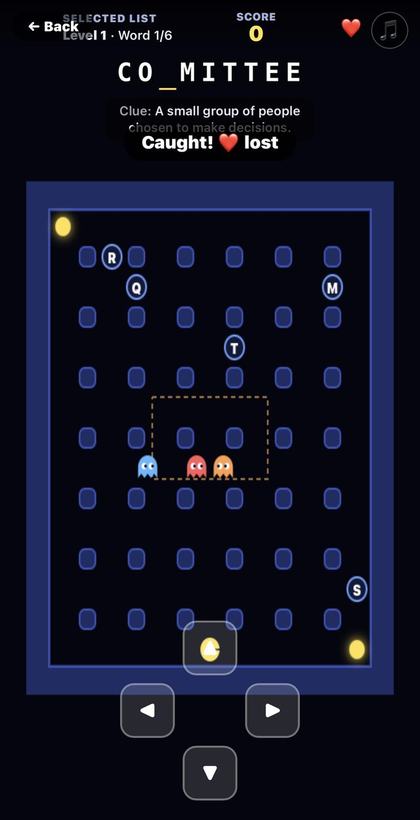
Letter Maze takes the identical core mechanic - a partly-blanked word, the missing letters scattered as pickups - and reframes it as a Pac-Man-style chase through a maze, ghosts and all. A child steers through corridors collecting the letters they need in order, while ghosts try to catch them; a power pill tucked in a corner briefly flips the chase, letting them turn the tables and clear ghosts out of the way instead of fleeing them.
Where Letter Climb is climb-and-dodge, Letter Maze is chase-and-evade - a different pressure profile that suits different children. The skill it's really exercising is holding a partly-completed spelling in mind while steering and reacting to a moving threat: working memory under pressure, rather than the more static recall of stopping to think. Maze layout complexity and ghost speed both scale to age band, using the child's current word list throughout. Like Letter Climb, it's a short, high-intensity session rather than a marathon - 400 coins unlocks 3 plays.
Worth watching for: if a child keeps getting "caught" while trying to reach the same letter, that's a decent signal the word is worth a calmer, slower look together outside the game - the maze surfaces the hesitation before a written test would.
Boggle: the one game that lets a confident speller go off-list
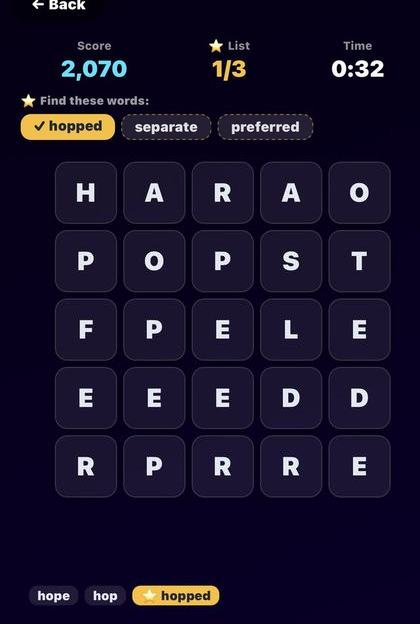
Boggle is the odd one out in a good way - it's the only game in the arcade that isn't built strictly from the assigned word list. It's the classic format: a 4×4 grid of letters, and the child traces a finger across touching tiles - across, down, or diagonally - to spell out as many valid words as they can before the timer runs out. Any valid English word scores. But their current spelling-list words are flagged on the grid and worth a large bonus if they find them, so there's still a strong pull toward the words they're actually meant to be learning.
That open-endedness is the point. Where Letter Climb and Letter Maze are structured drills wearing an arcade costume, Boggle is closer to genuine word fluency and letter-pattern spotting - it rewards a confident speller for ranging beyond the assigned list while still crediting them extra for hitting it. It's also the most generous unlock in the arcade: 350 coins buys 10 plays (against 3 for Letter Climb or Letter Maze), reflecting that it's a slower, more open-ended format rather than a quick burst.
Worth trying: Boggle is genuinely good to play alongside a child, or hand to an older sibling - the open word-finding format works across mixed abilities in a way the more tightly-scripted games don't, so it's one of the few spots in the app where a whole family can play the same round together.
Finish a game, send a challenge
Once a child finishes a round, they can send a challenge - a link that puts a friend, sibling or cousin into the exact same game, with the exact same words, chasing the same score. Whoever set the challenge can see whether it's been beaten. It works across every game in the arcade: Balloon Pop, Letter Climb, Letter Maze, Word Search, Boggle, Word Builder, Word Lock and Ring.
There's no account needed to accept a challenge - just the link. That's deliberate: the point is a quick, low-friction "beat my score," not another sign-up flow standing between a child and the fun part.
Not every child wants the competition
Streaks, leaderboards and a countdown clock motivate plenty of children - and stress others out. A child who freezes up the moment a timer appears, or who just doesn't want their score measured against anyone else's, shouldn't have to skip the games to avoid that. Low-pressure mode (parental controls → Accessibility, set per child) turns the competitive layer off: every game hub - including Letter Climb's, Letter Maze's and Boggle's - drops its Hall of Fame and leaderboard links, and in the games with an on-screen clock or streak badge (Balloon Pop/Spell Buzz, Word Search, Spell Sprint, Ring) the countdown and streak disappear too, with the timed ones switching to run untimed instead. Nothing about the words, the scoring that feeds coins, or what counts as practice changes - it's the same game, just without the racing-the-clock framing.
Because it's set per child rather than per household, one sibling can keep the streaks and leaderboard on while the other has it off - useful if the games hit differently across siblings, or for a child who's more sensitive to time pressure generally.
Parents set the price - and the pace
The cost of unlocking a game, and how many plays a purchase buys, aren't fixed either. In parental controls, the Game prices & plays section lists every game with its coin cost and play count - the defaults in this post (350 coins for 3 plays on Letter Climb, 400 for 3 on Letter Maze, 350 for 10 on Boggle) are just the starting point. Make a favourite cheaper, make the more intense arcade games rarer, give a game more plays per unlock so a session lasts longer, or reset any of them back to the app default - it applies across all the children in your household. It's the same lever we described when the reward economy shifted to practice-first: coins only come from spelling practice, so a cheaper price or a bigger batch of plays just means less practice buys the same amount of game time, and vice versa. Most parents never need to touch it - the shipped defaults are there because they work for most children - but if a game runs too short, costs too much, or a child needs a longer play session to feel worth unlocking, it's a few taps away rather than something we'd have to change for everyone.
Competitive, personalised, and it keeps them coming back
Put together, that's the whole idea: games built from words your child is actually learning, not a generic word bank; enough variety that no single mechanic gets stale; a light competitive edge through challenges that turns "I got 340 points" into "beat my 340" for the children who enjoy that; and an easy way to turn all of that off, or retune the price and pace, for the ones who don't. None of it replaces real practice - coins and rank still come from spelling, not from playing - but it gives practice a reason to feel like play instead of a chore, on terms that fit the child playing it.
If there's a game mechanic you'd love to see spelling words turned into, tell us - the arcade keeps growing from exactly that kind of feedback.