
Drafted with AI assistance and reviewed, fact-checked and edited by hand before publishing - see our AI transparency page for how we use AI across the app.
Friday's test comes back: 8 out of 10. Good week. You say well done, the sheet goes in the recycling, and next Monday there are ten new words.
Here's the thing that score doesn't tell you. Two of those eight might have been words your child had typed four times that week, with the spelling flashed on screen thirty seconds earlier. One of them might be a word they can reliably write and always could. And the rule underneath all ten - the "-tion" ending, say, or the y that turns into an i before "-ful" - might be no more secure on Friday than it was on Monday.
A score measures a morning. It doesn't measure whether anything stuck.
Three rungs, and only one of them is a claim
So Spelling.Live no longer just tells you how a week went. Every spelling rule your child meets now sits somewhere on a three-step scale, and the app says plainly what would move it up.
Started. They've met the rule. There isn't enough yet to say anything useful, and we don't pretend otherwise.
Nearly there. They're getting it right in practice - typing it, saying it aloud, picking it out - across more than one word, recently, with no slip on that rule. This is real progress. It is not proof.
Secure. They have written the rule correctly from memory, with no help on screen, across three different words, on two different days.
Every clause in that last sentence is doing a job.
Written, because writing is what the Friday test asks for, and it's the only thing that predicts it. From memory, because a word you've just been shown is a word you're copying, however it got in front of you. Three different words, because one word written three times is repetition - three different words is transfer, which is the thing that actually means they've got the rule rather than the word. And two different days, because one good sheet is a good sheet.
There's a fourth rung nobody sees much: Time for a refresher. Rules go quiet. A child who nailed "-tion" in October and hasn't met it since November hasn't lost anything - it's just been a while. The app says so in those words, because that's what happened.
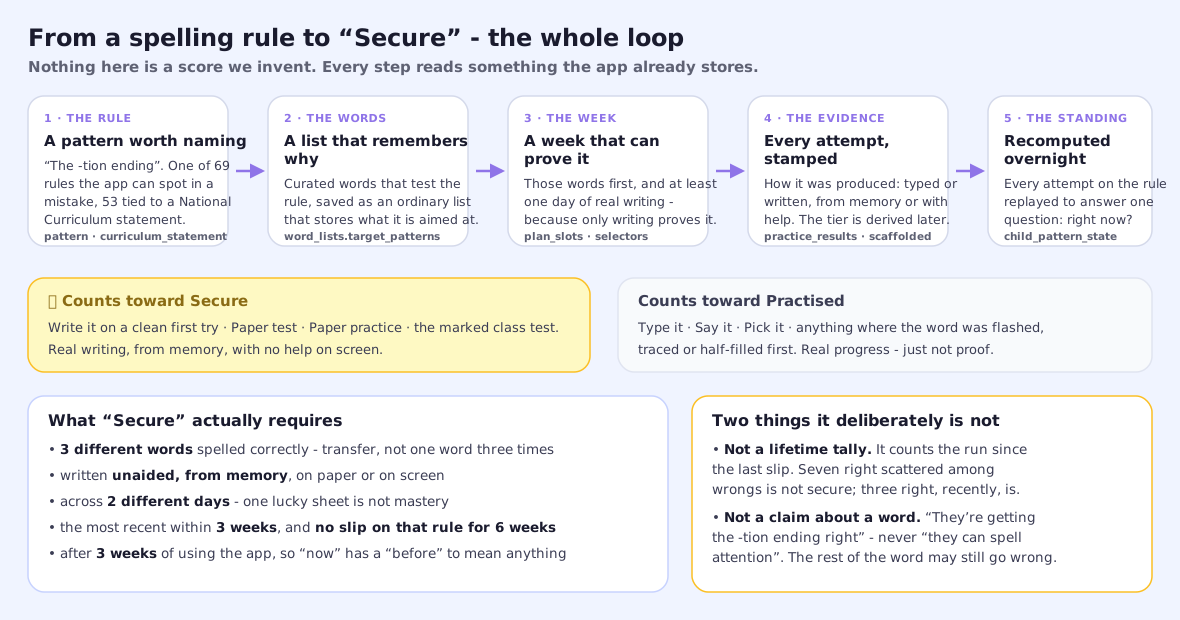
A run, not a tally
The other decision worth explaining is what gets counted.
The obvious way to build this is to add up every correct answer a child has ever given on a rule. We deliberately don't. What counts is the run since the last slip.
Seven right answers scattered among wrong ones is not a secure rule. Three right, recently, with nothing going wrong in between, is. A lifetime tally hides exactly the thing you want to see, which is whether they're getting it right now.
One consequence surprises people, so it's worth saying out loud: a rule can be Secure on a word your child still can't spell. If they write "seperate" for "separate", that's a schwa mistake - the long vowel elsewhere in the word was fine. Counting that against every rule the word happens to contain would make almost every rule look broken. So the app is careful about what a mistake actually implicates, and every sentence it shows you is about the rule, never about one word. You'll never see "they can spell attention". You'll see "they're getting the -tion ending right", which is the claim the evidence supports.
What we do about it, not just what we noticed
A diagnosis you can't act on is a nicer way of saying nothing. So when a week is aimed at a rule, the plan does two things.
It puts that rule's words first, so a session capped at six words spends them on the thing you're working on rather than on whatever happened to be at the top of the list. And it makes sure at least one day of the week asks your child to write.
That second one matters more than it sounds. One of our week templates is typing every day. A child on it could practise a rule perfectly for a whole term and never reach Secure - not because they can't write it, but because the week never asked them to. So a week with a goal now gets a written day, by converting a typing day rather than adding one. Same week, same length, one day doing a different job.
And when you open your child's plan, the first thing on the page is what they're working towards, how far off it is, and one thing you could do about it in five minutes - starting the practice itself, not another settings screen. If you're on a laptop, that action is a paper one: the computer reads the words out, your child writes them, you photograph the page. Writing on a screen with a mouse isn't writing, so we don't pretend it is.
"Is my child on track?"
This is the question every parent actually wants answered, and it's the one place we've deliberately stopped short.
The app will tell you what has moved: two rules became Secure since September, three more are close, your child wrote on nine different days. All of that is something that happened, and we can show you the evidence for every word of it.
What it won't do is put a verdict on it - on track, behind, ahead for Year 4. Not because it wouldn't be reassuring, but because it wouldn't be honest. The rules we can report on are the ones we've seen your child practise, which isn't the same as their spelling as a whole. A confident-sounding number built on that would be measuring our own coverage and calling it your child's attainment.
For where they actually sit against their school year, the Skills Check is the right instrument, because it tests rather than counting. The app points you there instead of guessing.
If the curriculum isn't your yardstick
Everything above is tied to National Curriculum English Appendix 1 - the statutory spelling content for England. For a lot of families that's exactly right: it's what school is teaching and what the Friday test comes from.
For plenty of others it isn't. Scotland, Wales and Northern Ireland have their own. International and home-educating families have none of ours. And a child working a long way from their year group is not helped by being measured against it.
So there's a switch, per child, in their settings under "How they practise". Turn it off and the year framing goes: no coverage count, no statutory statements, no "Year 4 expects".
What stays is everything else. The whole Started - Nearly there - Secure scale, every badge already earned, the written-practice routes, the plan. The week still aims at spelling rules - it aims at the ones your child keeps getting wrong instead of the ones a year group expects.
That split is the point, and it's worth being clear about. Whether a rule is secure is a question about evidence. Which rules a school year expects is a separate question. Tying them together would have been easier to build and wrong for anyone outside one country's syllabus.
If your child has no school year set, or is past Year 6, it's off already - there's no year we could honestly head the screen with.
The short version: a score tells you about a morning. Three different words, written from memory, on two different days, with nothing going wrong in between, tells you the rule has stuck. That's what Secure means now, and the app will tell you exactly how far off it is.