
There's a problem most spelling apps quietly ignore: spelling and handwriting are taught together in school, but practised separately at home.
Your child's teacher notices when letters are reversed, when a 'b' looks like a 'd', when words are squashed together or floating apart. But when your child practises spelling on most apps at home, nobody is looking at the writing at all.
Spelling.live fixes that.
What Other Apps Actually Check
When most apps offer a "write the word" mode, they do one very simple thing: check whether the end result looks roughly like the right word.
They are not checking how the letters were formed. They don't care if your child wrote a mirrored 'b', a squashed 'a', or joined letters the wrong way. As long as the AI can recognise the word, it passes.
For early writers, this misses the most important part. Letter formation habits - good and bad - are set in the first few years of school. Catching a reversal at age 5 is easy. Unlearning it at age 9 is much harder.
What Spelling.live Actually Checks
When your child writes a word on screen, we capture every stroke and analyse the result using GPT-4o - the same AI vision technology used by researchers and specialists. We're not just asking "what word is this?" - we're asking "how well was each letter formed?"
For every letter, we look at:
- Shape and visual correctness - does each letter look right, or is it malformed?
- Letter reversals - are they writing b instead of d, or p instead of q? One of the most common early years issues, and one most apps miss entirely
- Missing or extra strokes - did they forget the crossbar on a t, or add an extra hump to an n?
- Proportions - are tall letters tall enough? Are round letters too squashed or too wide?
- Spacing - are letters crammed together or floating apart?
- Uppercase confusion - writing A when they should be writing a
- Hesitation and shakiness - signs of uncertainty that can hint at a letter they're not confident with
- Whether a handwriting mistake caused the spelling mistake - sometimes what looks like a spelling error is actually a writing error
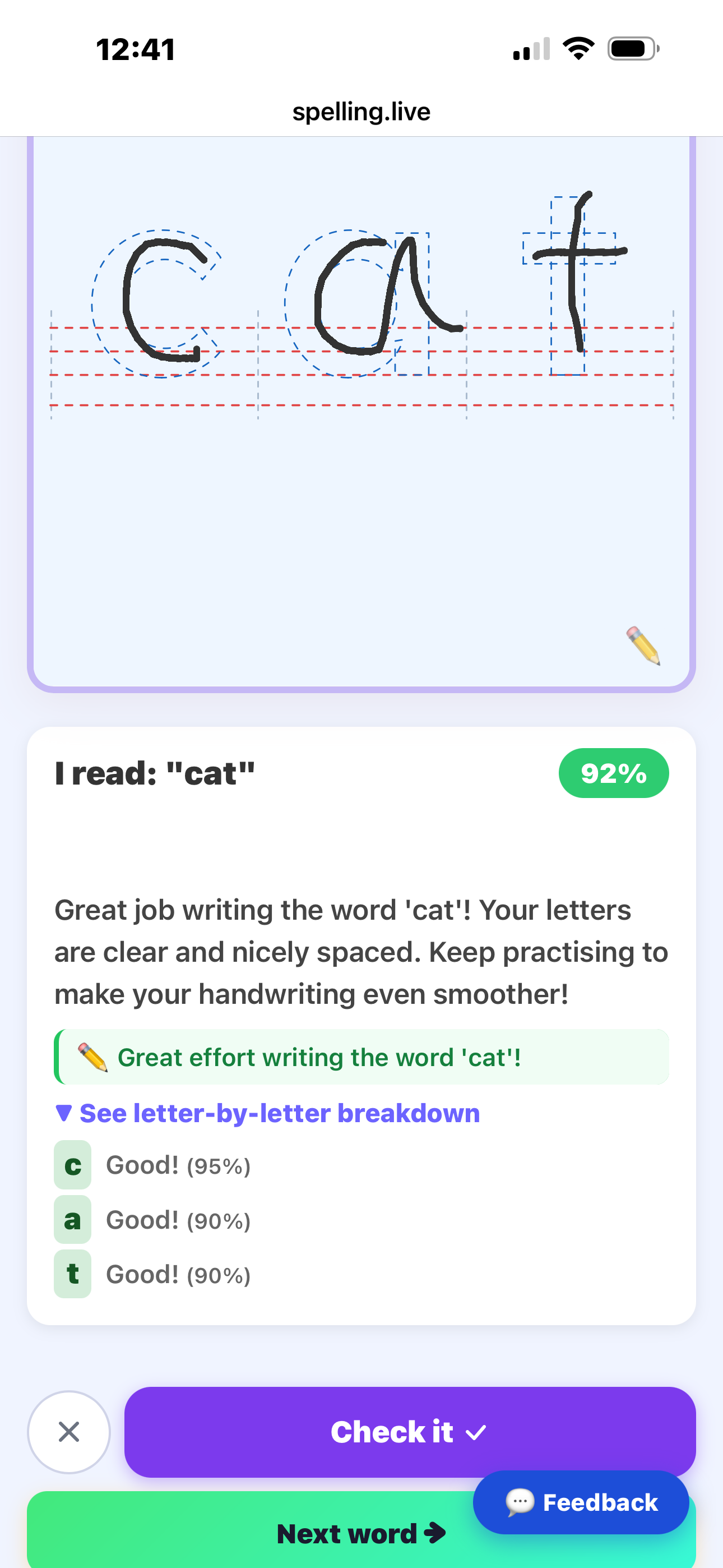
The feedback appears the moment they tap "Check it" - instant, specific, and encouraging.
Different Feedback for Different Ages
Handwriting development looks very different at 5 than at 11, and so does our feedback.
EYFS and KS1 - ages 4 to 7
For younger children, every letter gets its own assessment:
- A severity rating: none, minor, moderate, or significant
- A short, encouraging message the child can understand and act on immediately
- A separate note for the parent or teacher - the specific issue, why it matters, and what to practise next
The child sees something simple and positive. The parent sees the detail they need to help.
KS2 - ages 7 to 11
Older children get a structured analysis across five dimensions, each scored out of 100:
- Joins - are letters connected correctly where expected?
- Slant - is the writing consistently angled?
- Baseline - are letters sitting on the line, or bouncing above and below?
- Spacing - consistent gaps between letters and words
- Overall legibility - how readable is the writing as a whole?
The scores are shown on a radar chart - your child's profile plotted against a typical year-group band - with a written breakdown of strengths and areas to work on.
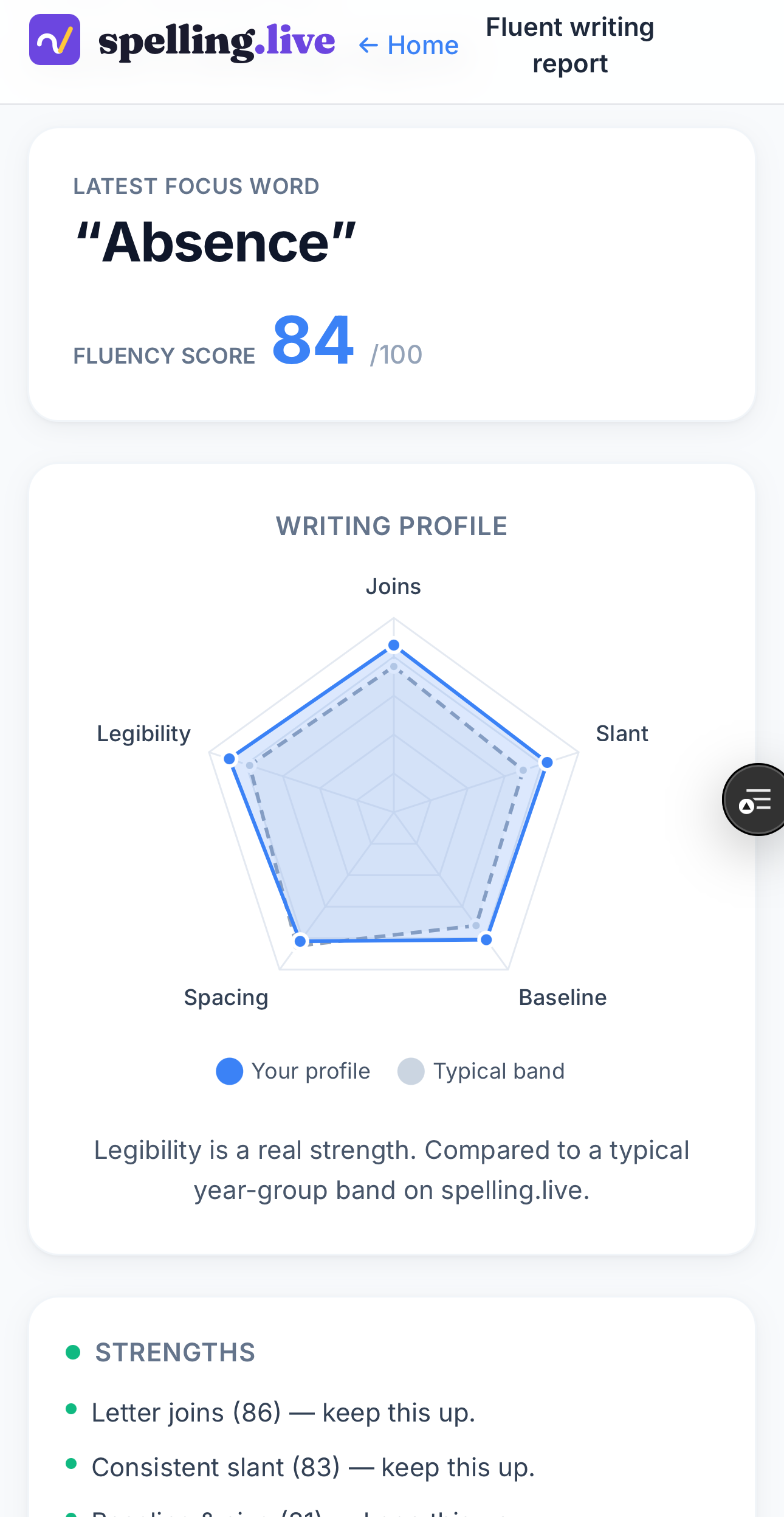
This mirrors the feedback a teacher would give in a handwriting lesson, translated into something measurable and trackable over time.
The Formation Report
Each session, your child's letter formation data is saved. Over time, this builds into a formation report - a clear picture of which letters they form confidently, which are improving, and which need more work.
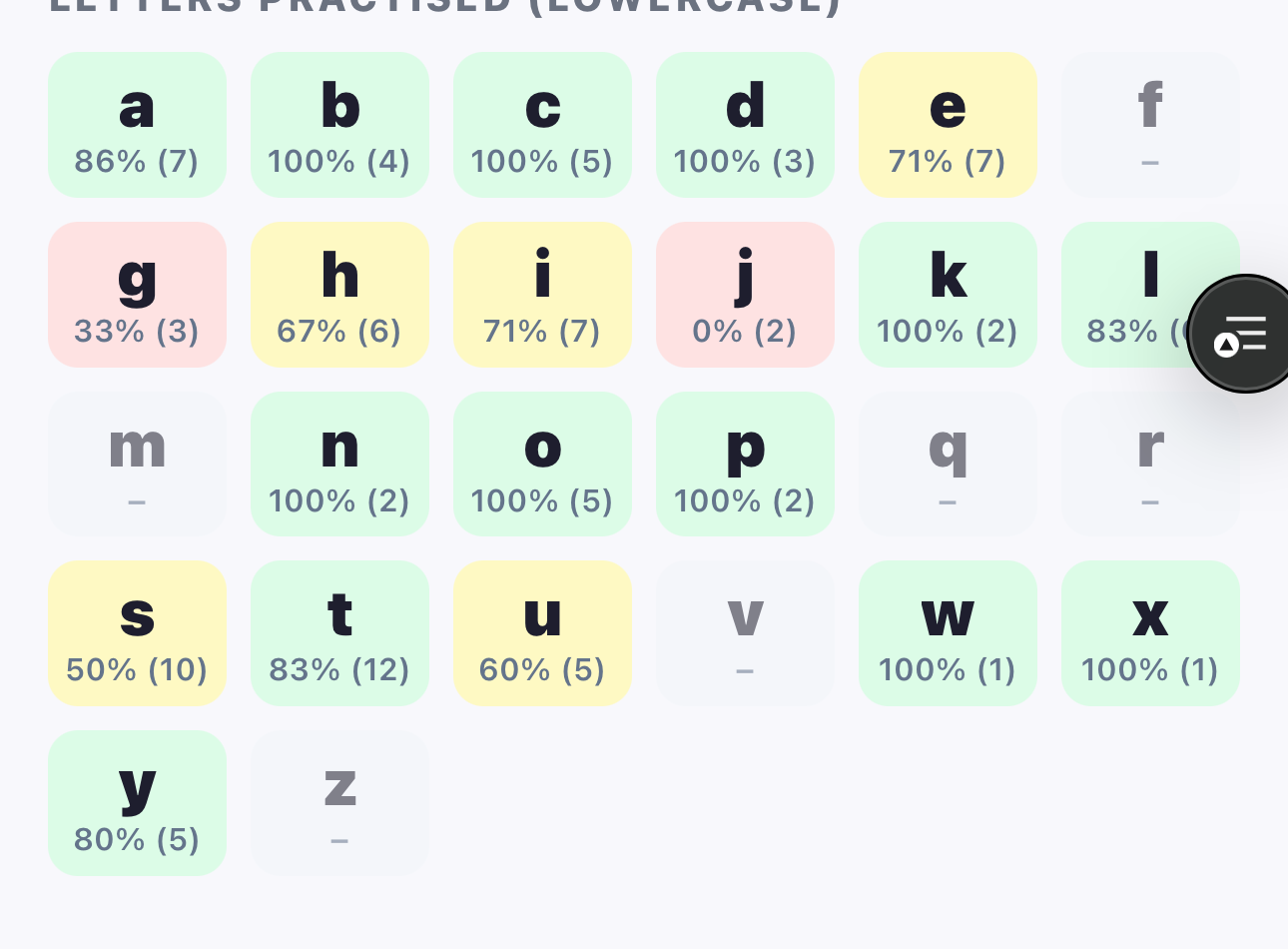
The colour coding makes patterns obvious at a glance. Green tiles are solid. Yellow tiles are developing. Pink tiles need attention. The number in brackets shows how many times that letter has been practised.
This kind of ongoing view is what turns practice into real progress. A child can spell correctly for weeks while still forming their 's' or 'g' incorrectly - something you'd only spot if you were tracking it session by session.
Why This Matters More Than It Might Seem
Handwriting difficulties are one of the most commonly flagged concerns in UK primary schools, particularly for children with dyslexia, dyspraxia, or other additional needs. For these children, poor letter formation can directly cause spelling errors - they write what they intend to write, but the letter comes out as something else.
Our analysis separates the two: was this a spelling mistake, or a writing mistake? That distinction changes what you practise next.
For SEN learners, we also offer a gentler mode with lower correction thresholds. For very young writers, a letter trace overlay shows the correct letter shape underneath their writing as a guide.
Handwriting and Spelling Together
Most tools treat handwriting and spelling as separate subjects. But in KS1 spelling practice especially, the two are inseparable - a child who can't form a letter clearly will struggle to write it correctly under test conditions, no matter how well they know the word.
Spelling.live is the only app we know of that combines spelling practice and handwriting analysis in a single session, with feedback that works for the child in the moment and a formation report that gives parents and teachers the bigger picture.