
Homophones are the trickiest thing on the whole KS2 spelling curriculum, for one simple reason: the mistake doesn't look like a mistake. Write "hear" when the test word was "here" and every letter is spelled correctly - it's just the wrong word. A teacher marking by eye has to actually read for meaning, not just check the letters, to catch it. That's a much easier thing for a human - or an app - to miss than a plain misspelling like "recieve".
Spelling.Live's Paper practice feature - photograph a marked spelling sheet and it reads the whole page - is built to catch this exact trap.
What this looks like on paper
Here's a typical homophones list, marked the way a parent or teacher would mark it at home - a tick for right, a cross for wrong:
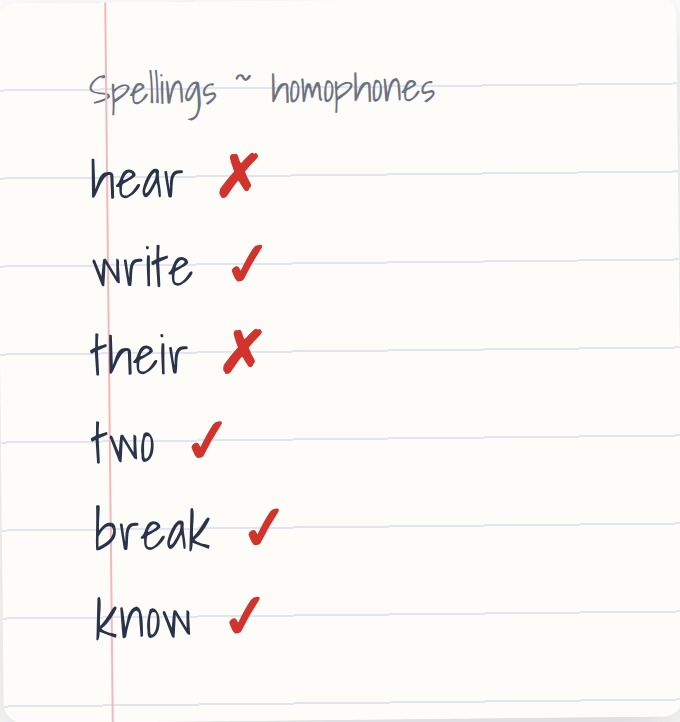
Look closely at the two crossed words: "hear" and "their". Both are spelled perfectly. Both are real English words. And both are wrong, because the test wanted "here" and "there". A generic spellchecker sees a correctly spelled word and has nothing to flag. Even a careful parent, scanning quickly down a list of ticks, can read straight past it.
What Paper practice does with it
Take a photo of the sheet, and the review screen doesn't just copy down the ticks and crosses - it notices when a crossed word is itself a real, correctly spelled word, and offers the likely intended target as a one-tap suggestion, drawn from a curated set of 80+ homophone and near-homophone pairs from the DfE's Year 3-6 spelling lists ("there / their / they're", "hear / here", "which / witch", "practice / practise", "affect / effect", and more):
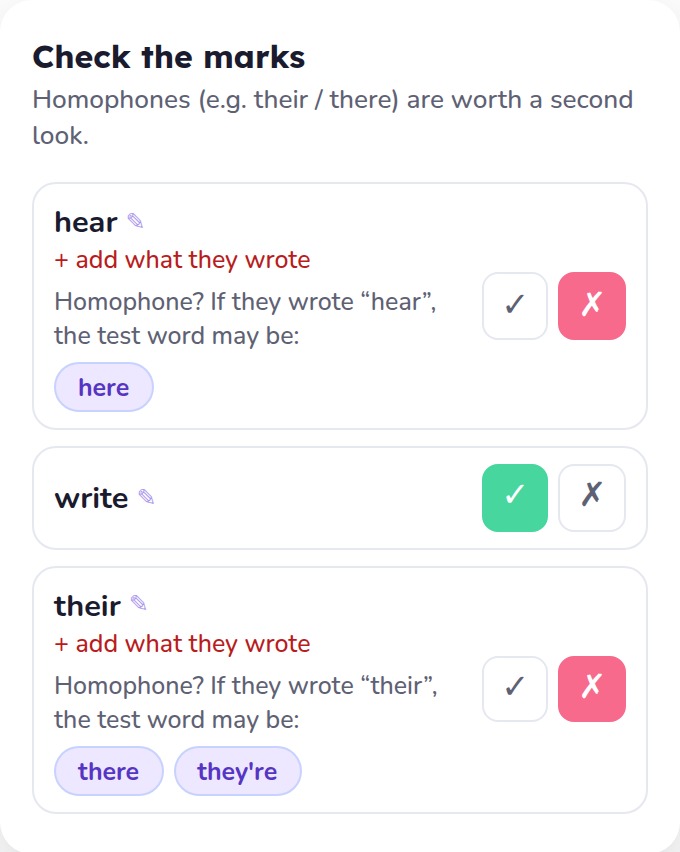
Tap "here" and the row instantly becomes: target word here, written as hear - exactly what happened on the page, recorded correctly instead of looking like your child simply got their own word wrong for no reason.
Why the distinction matters
Getting this right isn't just tidiness. It changes what shows up in the progress report:
- The right word gets the miss. Without the homophone check, a misread sheet can credit the wrong word entirely, or show a miss with nothing to explain it.
- The pattern gets recognised. A homophone mix-up is a completely different kind of mistake from a misspelling - confusing two real words that sound alike, not getting the letters wrong. Spelling.Live's pattern engine treats it as its own category, so it shows up correctly in "Finding tricky" instead of vanishing into a generic "wrong" bucket.
- You still get the final say. Nothing is guessed silently - every suggestion is a tap-to-accept chip on the review screen, and every mark stays editable before you save.
What it costs
The homophone check runs automatically as part of reading the sheet - there's no extra step and no extra charge for it. It's the same 10 credits for a sheet of up to 15 words (plus 2 more if handwriting scoring runs too) as any other Paper practice session - no separate charge and no subscription tier to unlock it. See how credits work for the details.
Try it on this week's homophones list
If your child's class sets a "there / their / they're" or "hear / here" style list this term, Paper practice is built for exactly that sheet - whether your child is just starting out with early spelling lists or working through the fluent-band curriculum. Photograph it the way you would any other marked test, and the review screen will flag the homophone mix-ups for a second look rather than letting them slip past as a plain miss - or worse, look like a word your child never got wrong at all.
For the full picture of how a photographed sheet becomes progress-report data - including handwriting scoring - see our guide to Paper practice. And for more on how the app tells one kind of spelling mistake from another, read about the 18 KS2 spelling patterns behind every miss.