Most spelling apps make your child practise all twenty words on this week's list, even the fifteen they already know. Spelling.Live starts with the ones they actually get wrong. That's ten focused minutes of weekly spelling test practice instead of forty frustrated ones.
 Rated 5.0/5, Educational App Store Certified. No credit card needed to start.
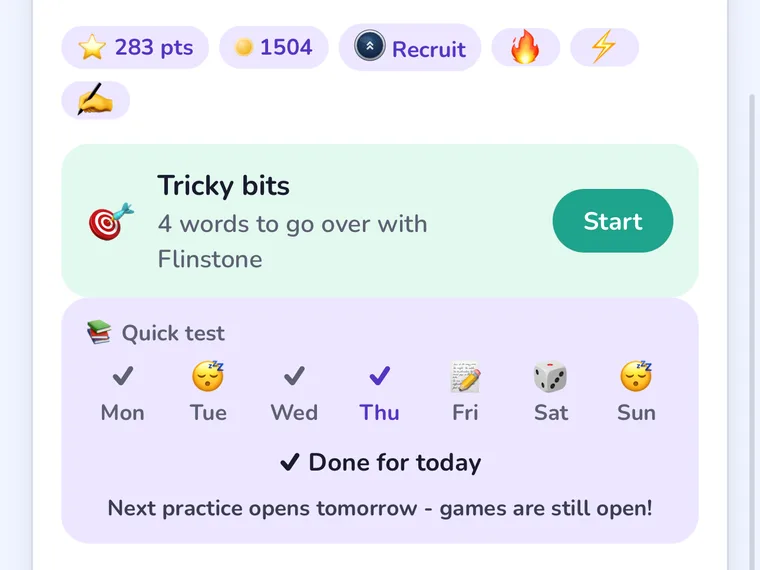
Every parent knows the routine: Friday's list comes home, and Monday to Thursday becomes a ritual of reading out every word, every night, whether your child needs it or not. It's exhausting, and it isn't actually how children learn to spell.
Ten minutes a night on words your child already knows cold is ten minutes not spent on the ones that trip them up.
Drilling a word your child has already mastered doesn't build spelling - it builds boredom, and sometimes resentment.
A child who "passes" a list by rote often can't tell you why a word is spelled that way - so nothing sticks for the next test.
You end up marking, correcting and reminding every evening - a second job on top of the one you already have.
Most spelling practice - on paper, in an app, or the "look, cover, write, check" method every school still uses - is built around the whole list. It's a good starting point. Spelling.Live simply takes it a step further by finding out what your child needs before deciding what they practise.
Start with what your child gets wrong. Everything else follows from that.
Give your child a proper first attempt at this week's list - on paper, read aloud, exactly like the real test they'll sit at school. No app, no hints, just a fair first go. This is what tells us what's actually worth practising.
30-second demo: adding this week's list
Photograph the marked sheet and Spelling.Live reads the ticks and crosses for you - or type in what they got right and wrong in a few taps. Either way, you're done in under a minute, with nothing to write up by hand.
30-second demo: paper practice, scanned and marked
This is where Spelling.Live earns its name. Instead of just logging "wrong", it looks at how your child got a word wrong - a silent letter, a mixed-up vowel sound, a tricky suffix - and works out the pattern behind the mistake, not just the mistake itself.
Practice time is now spent entirely on the words - and the patterns - that need it. Your child works through them by typing, writing by hand, saying the word aloud, or picking the right spelling, with games woven in as a reward rather than the whole workout.
A word that was tricky last month doesn't just disappear once it's "learned" - it quietly resurfaces later, spaced out over time, until your child genuinely owns it. That's how tricky words stop being tricky for good, rather than being crammed the night before and forgotten the week after.
Every session is built from your child's own mistakes, not a generic list.
Spaced repetition brings hard words back at just the right moment, so they stick.
Typing, handwriting, saying words aloud and quick-fire games - whatever suits how they learn.
Paper practice and dictation tests that mirror the real weekly spelling test format.
A clear report of what's improving, what's still tricky, and what to focus on next.
Diagnoses the pattern behind a mistake, not just that a word was wrong.
"Spelling.Live goes well beyond traditional spelling apps and already stands out as one of the most complete spelling practice solutions available for UK primary learners." - Educational App Store, 5.0/5 Certified review
"We used to spend forty minutes a night going through the whole list. Now it's ten minutes on the three or four words she actually needs, and she gets far more right on test day."
- Parent of a Year 3 pupil
"As a tutor I can see exactly which pattern is tripping a pupil up before our session even starts. It's cut my prep time right down."
- Primary tutor
"My son used to dread spelling homework. Now he asks to do it, because it's quick and he can actually see himself getting better."
- Parent of a Year 5 pupil
A spelling game is great for five minutes of fun, but tapping a balloon under time pressure is a different skill from writing a word from memory. Spelling.Live keeps the two separate on purpose: games sit on top as a reward, while your child's real weekly spelling test practice is built from genuine attempts - typing, writing, saying the word aloud, or choosing the right spelling. Only real attempts feed their progress report and decide what they practise next.
Yes. Photograph the list your child brings home, type it in, or choose from the free National Curriculum word lists built into the app. Spelling.Live builds that exact week's practice around it, and can mark a photo of their completed paper test so you never have to type up results by hand.
No. Children can type, write by hand with a finger or stylus (the app checks handwriting with AI), say the word aloud, or choose the correct spelling from options - whichever matches their age and how their real test works. Most families mix it up through the week.
Yes. Tutors get their own free credit allowance, can manage multiple pupils, assign different word lists to each one, and see exactly which patterns a pupil needs to work on before their next session.
Yes. Teachers get a free credit allowance and a class dashboard for setting up a whole class at once, running a bulk paper spelling test that's scanned and marked automatically, and seeing which pupils and patterns need attention before the next lesson.
Ages 5 to 11. Early years practice (roughly 5-7) leans on pictures, letter tracing and shorter words; upper primary practice (roughly 9-11) adds harder vocabulary, spelling patterns and 11+ style test preparation. The app adjusts automatically as your child grows.
If you've ever sat at the kitchen table running through the same twenty words for the third night in a row, you already know the problem with most spelling practice: it treats every word as equally important, when in reality your child probably has it right for fifteen of them already. Weekly spelling test practice doesn't need to mean reading the whole list out loud every evening. It needs to mean finding the two or three words that are genuinely giving your child trouble, and spending your limited time there.
This isn't just a hunch - it's how memory actually works. Repeating something you already know does very little for long-term recall; the effort has to go into the words that are still shaky. Teachers call this "closing the gap," and it's the same principle behind good spelling activities in any classroom: identify what a child doesn't yet know, then give them focused, repeated exposure to exactly that, rather than diluting their attention across everything. When practice spelling words this way, children spend less time overall and remember more of it, because none of that time is wasted on words they'd already mastered.
Most spelling practice for children stops at "right" or "wrong." A good online spelling trainer goes a layer deeper and asks why a word was wrong. Did your child drop a silent letter, like the "k" in "knight"? Mix up a vowel sound, like "ie" and "ei"? Miss a doubled consonant when adding an ending, like "stopped" versus "stoped"? Each of these is a pattern, not a one-off. A child who understands the pattern behind a mistake can apply that understanding to dozens of other words they haven't even met yet - which is the real goal of any children's spelling programme, not just passing this Friday's test. This is exactly what Spelling.Live's AI-powered spelling analysis is built to do: it doesn't just mark a word wrong, it works out which spelling rule tripped your child up, so the practice that follows actually targets it.
Confidence in spelling doesn't come from being told a word is easy. It comes from a child seeing, in black and white, that the list of words they find hard is shrinking week by week. That's why the very first step in Spelling.Live's approach is a genuine, unaided attempt at the test - on paper, exactly as it will happen at school - rather than a guided practice run where the app is quietly helping all along. A test attempt gives you (and the app) an honest picture of where things stand. Everything after that, from spelling activities to games to spaced repetition, is built on that honest picture, which is what makes the confidence real rather than manufactured.
Good spelling practice for children isn't one thing - it's several, used at the right moment. Typing suits a child preparing for an online spelling test; writing by hand matters for a child whose school test is on paper; saying a word aloud helps build the sound-to-letter connection that so many spelling rules rely on; and quick multiple-choice rounds are a gentle way back in for a child who's lost confidence. An online spelling trainer that only offers one of these is only solving part of the problem. Spelling.Live deliberately mixes all four, matched to your child's age and how their real spelling test works, so "practice" never becomes a single repetitive chore.
The words on any given week's spelling test matter for Friday. The patterns behind them matter for every test after that. A child who has genuinely learned why "beautiful" keeps its "e" or why "receive" follows "i before e except after c" carries that rule into hundreds of future spelling words, long after this week's list is forgotten. That's the real payoff of starting with what your child gets wrong: not just a better score this Friday, but fewer words to worry about every Friday from here on.
Want a day-by-day routine to run alongside the app? Read how to help your child practise for a weekly spelling test at home for a Monday-to-Friday structure you can start tonight.
Start with what your child actually gets wrong. It's free to try, takes minutes to set up, and works with whatever spelling list your school has already sent home.
