
Drafted with AI assistance and reviewed, fact-checked and edited by hand before publishing - see our AI transparency page for how we use AI across the app.
These are the reports two teachers saw after their classes' first month on Spelling.Live. Both classes are at the same primary school, which started using the app in September and practises in a fixed slot in the school day (how schools are using it).
The screenshots are real. Pupil names and class names have been replaced before publishing. Every number, word and rule is exactly as the teacher saw it, and each one is also written out in the text below.
In short: across the two classes, 33 of 37 pupils practised and made 1,875 spelling attempts. The same two spelling rules came top in both classes. Neither teacher marked a thing.
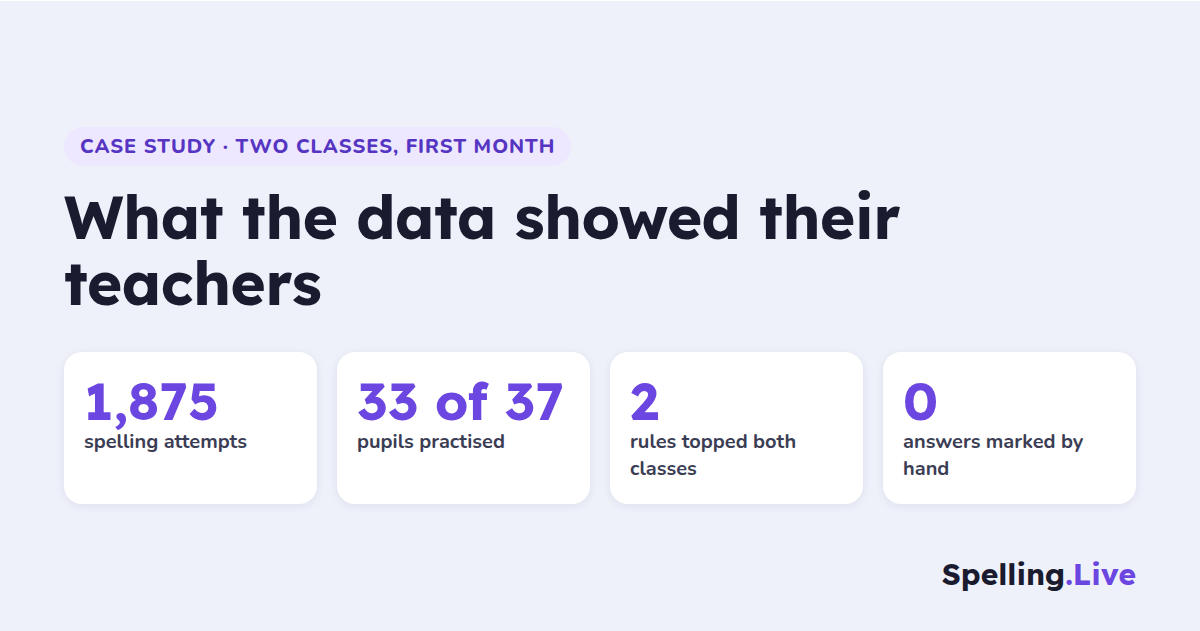
Class B: every pupil practising
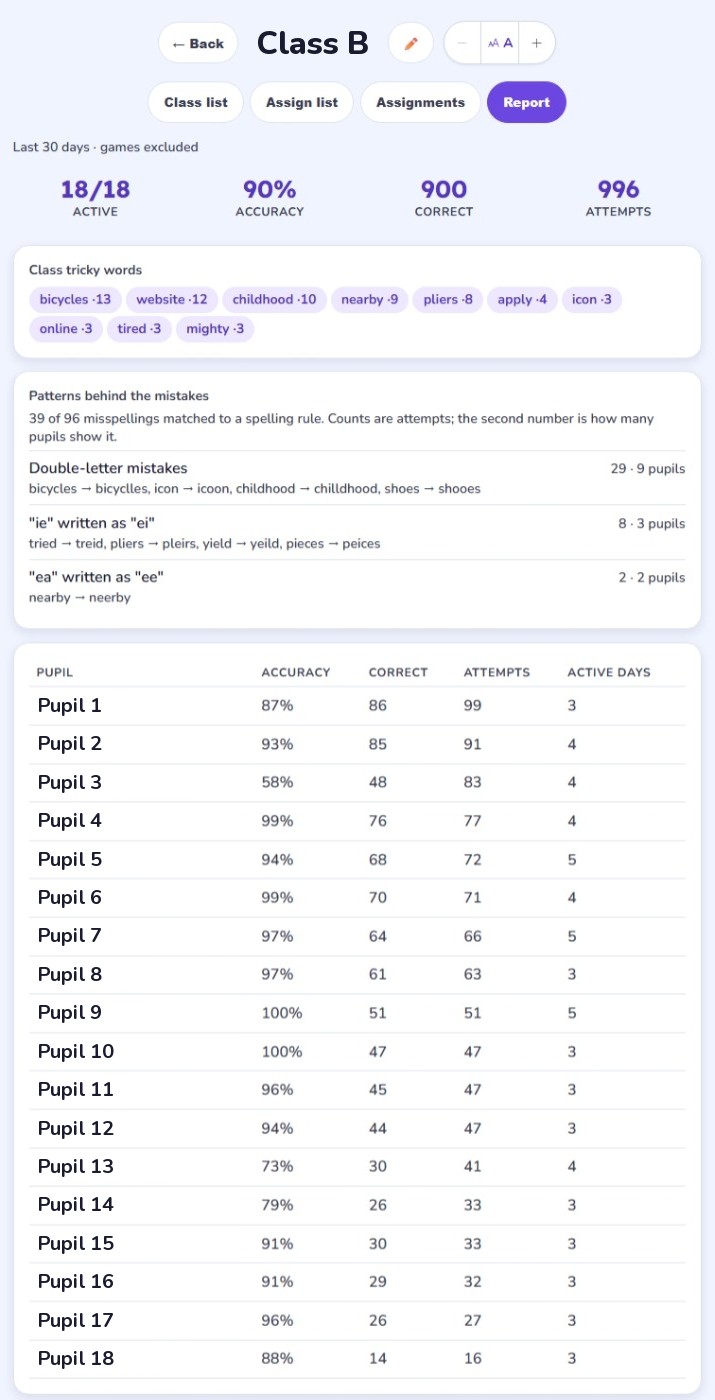
In the last 30 days, all 18 pupils in Class B practised. They made 996 attempts at 90% accuracy (900 correct), and every pupil practised on at least three different days. Games are excluded, so these are spelling attempts only.
The class's most-missed words were bicycles (13), website (12), childhood (10), nearby (9), pliers (8), apply (4), icon (3), online (3), tired (3) and mighty (3).
The patterns behind those mistakes, as text:
| Spelling rule | Example mistakes | Attempts | Pupils |
|---|---|---|---|
| Double-letter mistakes | bicycles → bicyclles, icon → icoon, childhood → chilldhood, shoes → shooes | 29 | 9 |
| "ie" written as "ei" | tried → treid, pliers → pleirs, yield → yeild, pieces → peices | 8 | 3 |
| "ea" written as "ee" | nearby → neerby | 2 | 2 |
39 of Class B's 96 misspellings matched one of these named rules. The rest were one-off slips (a missing letter here, a wrong letter there) that the pupils' own reports list word by word, rather than grouping them under a rule that doesn't really apply.
Who has done this week's list
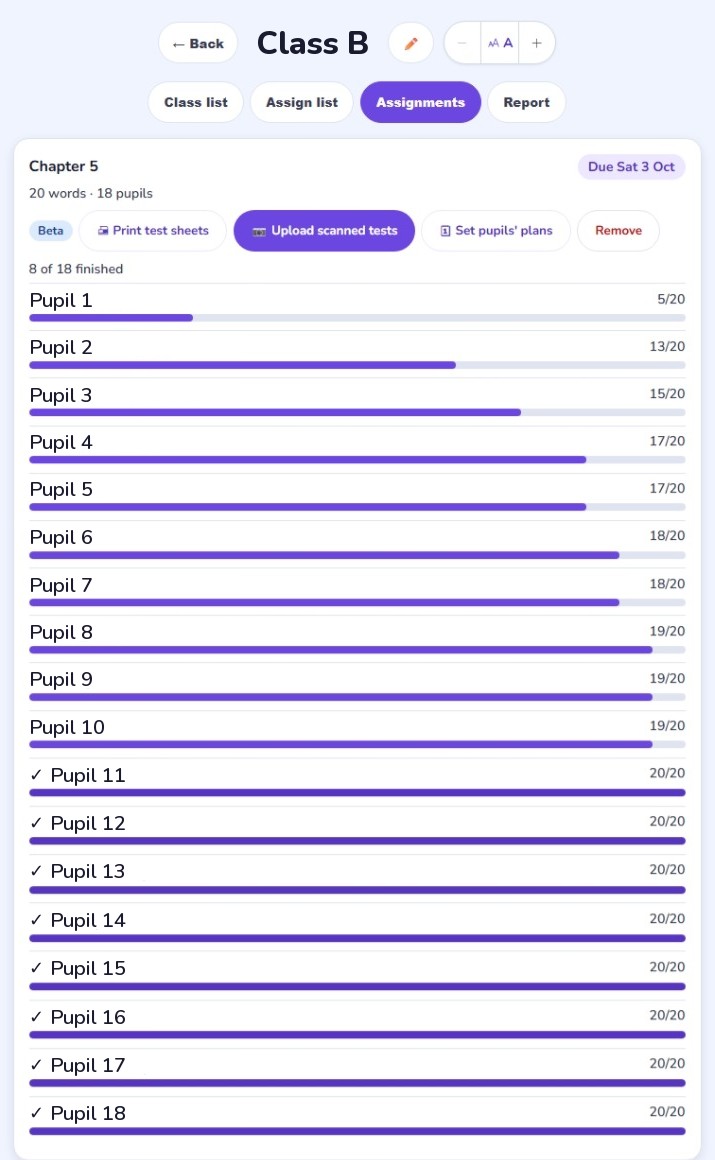
The teacher set a 20-word list due the following week. With several days still to go, 8 of 18 pupils had finished it. Of the other ten, seven were within three words of the end and one had just started.
Nothing here needed marking or collecting. From the same card the teacher can print personalised paper test sheets, upload the scanned tests to be marked, or set the pupils' practice plans for the next week.
Class A: two rules, not ten words
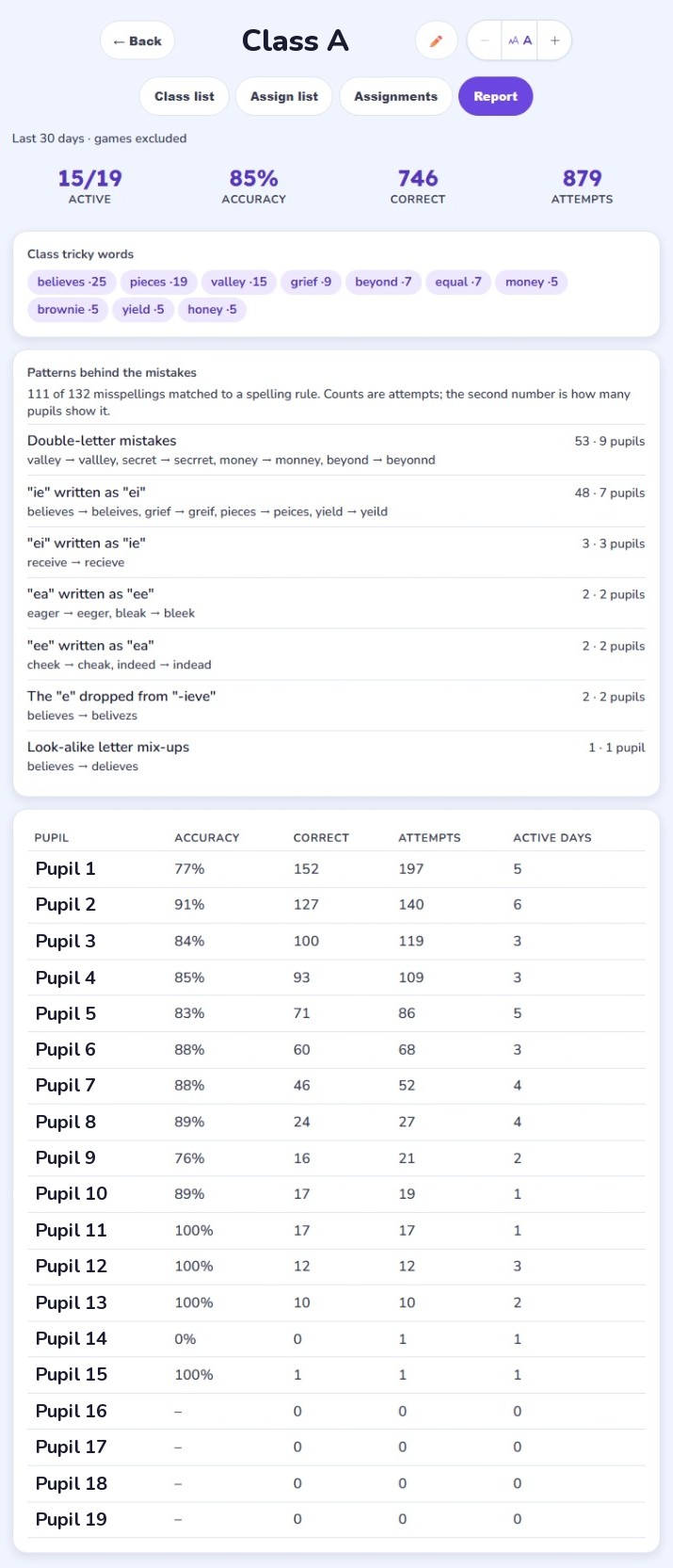
In Class A, 15 of 19 pupils practised, making 879 attempts at 85% accuracy. Here the rules explained far more of the mistakes: 111 of 132 misspellings matched a named rule.
| Spelling rule | Example mistakes | Attempts | Pupils |
|---|---|---|---|
| Double-letter mistakes | valley → vallley, secret → secrret, money → monney, beyond → beyonnd | 53 | 9 |
| "ie" written as "ei" | believes → beleives, grief → greif, pieces → peices, yield → yeild | 48 | 7 |
| "ei" written as "ie" | receive → recieve | 3 | 3 |
| "ea" written as "ee" | eager → eeger, bleak → bleek | 2 | 2 |
| "ee" written as "ea" | cheek → cheak, indeed → indead | 2 | 2 |
| The "e" dropped from "-ieve" | believes → belivezs | 2 | 2 |
| Look-alike letter mix-ups | believes → delieves | 1 | 1 |
Class A's most-missed words were believes (25), pieces (19), valley (15), grief (9), beyond (7), equal (7), money (5), brownie (5), yield (5) and honey (5).
A mark sheet would give this teacher ten red words. The report gives them one lesson on "ie" and "ei", which covers four of those ten words and 7 pupils.
The second number on each line matters as much as the first. A rule that 7 pupils are getting wrong is a whole-class teaching point. A rule that one pupil is getting wrong is a quick word with that child.
The same two rules, in both classes
The two classes had different word lists and different teachers, but their reports came out with the same two rules at the top:
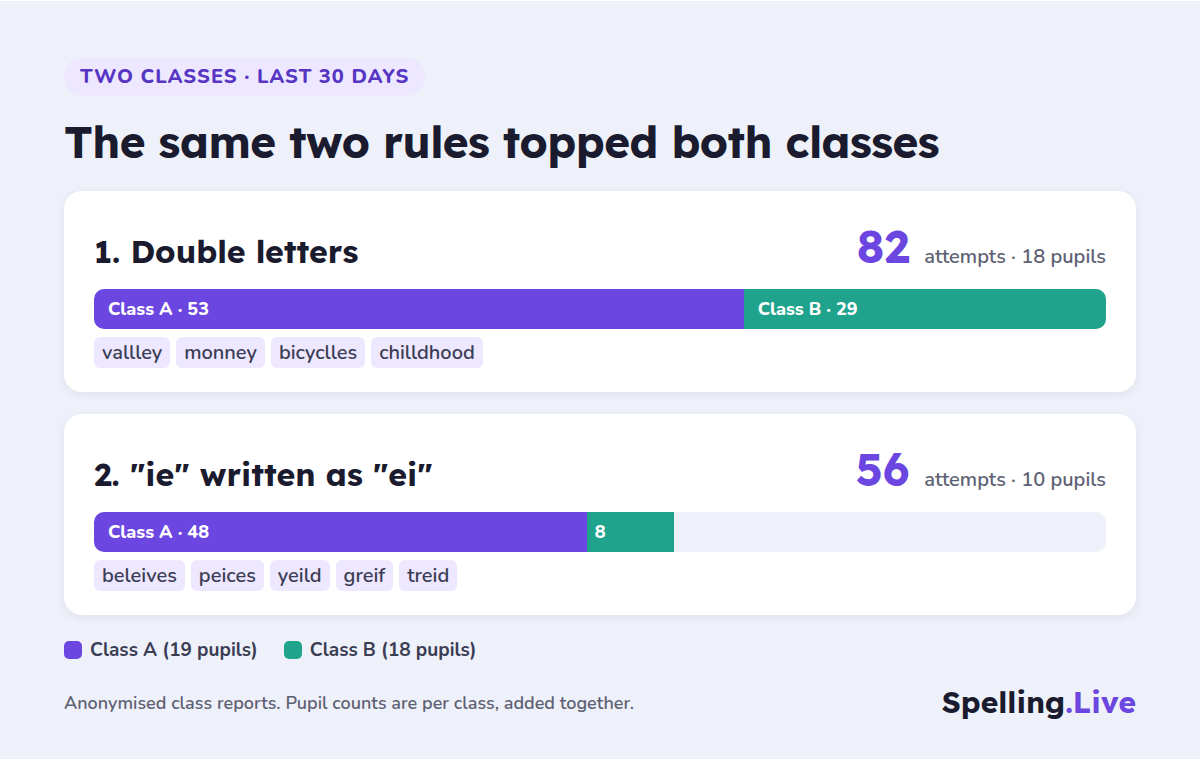
- Double-letter mistakes: 53 attempts across 9 pupils in Class A, 29 attempts across 9 pupils in Class B.
- "ie" written as "ei": 48 attempts across 7 pupils in Class A, 8 attempts across 3 pupils in Class B. Yield and pieces were misspelled as yeild and peices in both classes.
That is the kind of thing a teacher can act on across a year group, not just in one class.
One honest caveat: many of the double-letter mistakes came from Pick it, where the child chooses the right spelling from near-misses such as vallley and valley. Choosing the near-miss still shows the spelling isn't pinned down, but it is a recognition mistake rather than a written one. Each pupil's report shows which activity every mistake came from.
One pupil's report: the rule behind every miss
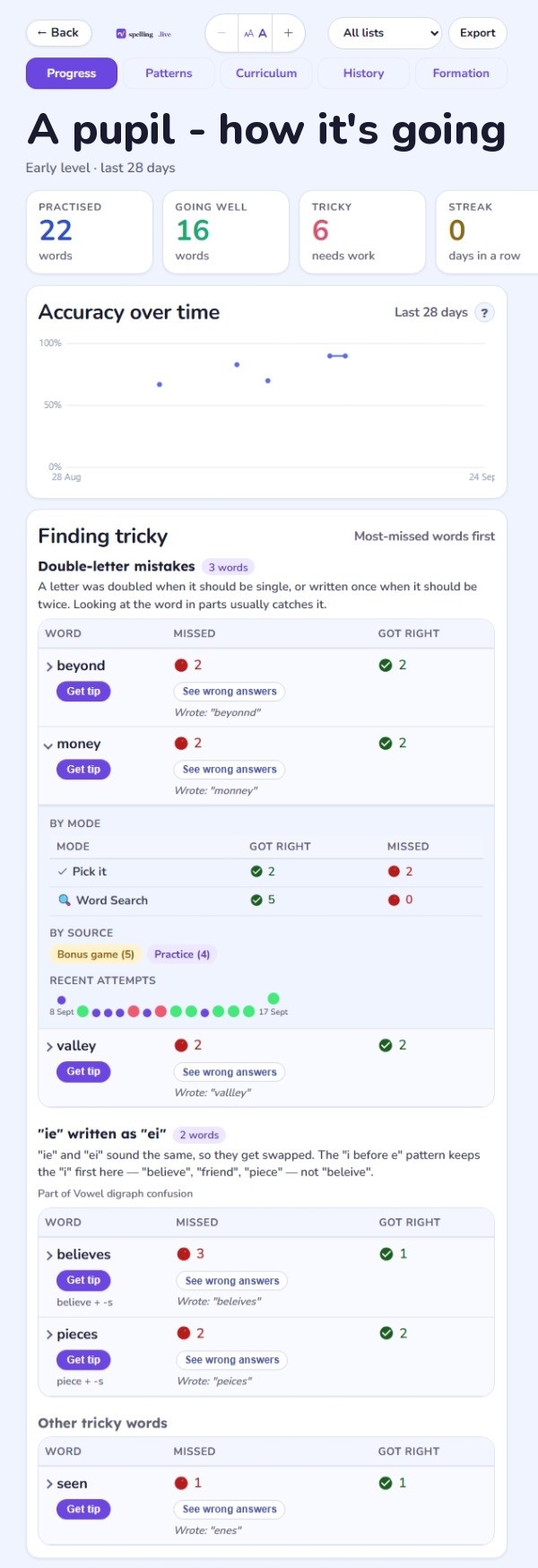
Open any pupil and the same diagnosis appears for that one child. This Class A pupil practised 22 words: 16 are going well and 6 are tricky. The tricky ones are grouped under the rule behind them, with a one-line explanation. Under "ie" written as "ei" it says: "The 'i before e' pattern keeps the 'i' first here - believe, friend, piece - not beleive."
In text, this pupil's report reads:
| Rule | Word | Missed | Got right | What they wrote |
|---|---|---|---|---|
| Double-letter mistakes | beyond | 2 | 2 | beyonnd |
| Double-letter mistakes | money | 2 | 2 | monney |
| Double-letter mistakes | valley | 2 | 2 | vallley |
| "ie" written as "ei" | believes | 3 | 1 | beleives |
| "ie" written as "ei" | pieces | 2 | 2 | peices |
Opening a word shows which activity each attempt happened in (Pick it, Type it, Write it or a game) and a timeline of recent attempts. So a teacher can see whether a mistake is becoming less frequent. The Get tip button next to each word gives a coaching tip based on that specific mistake (how the tips work).
Handwriting, not just spelling
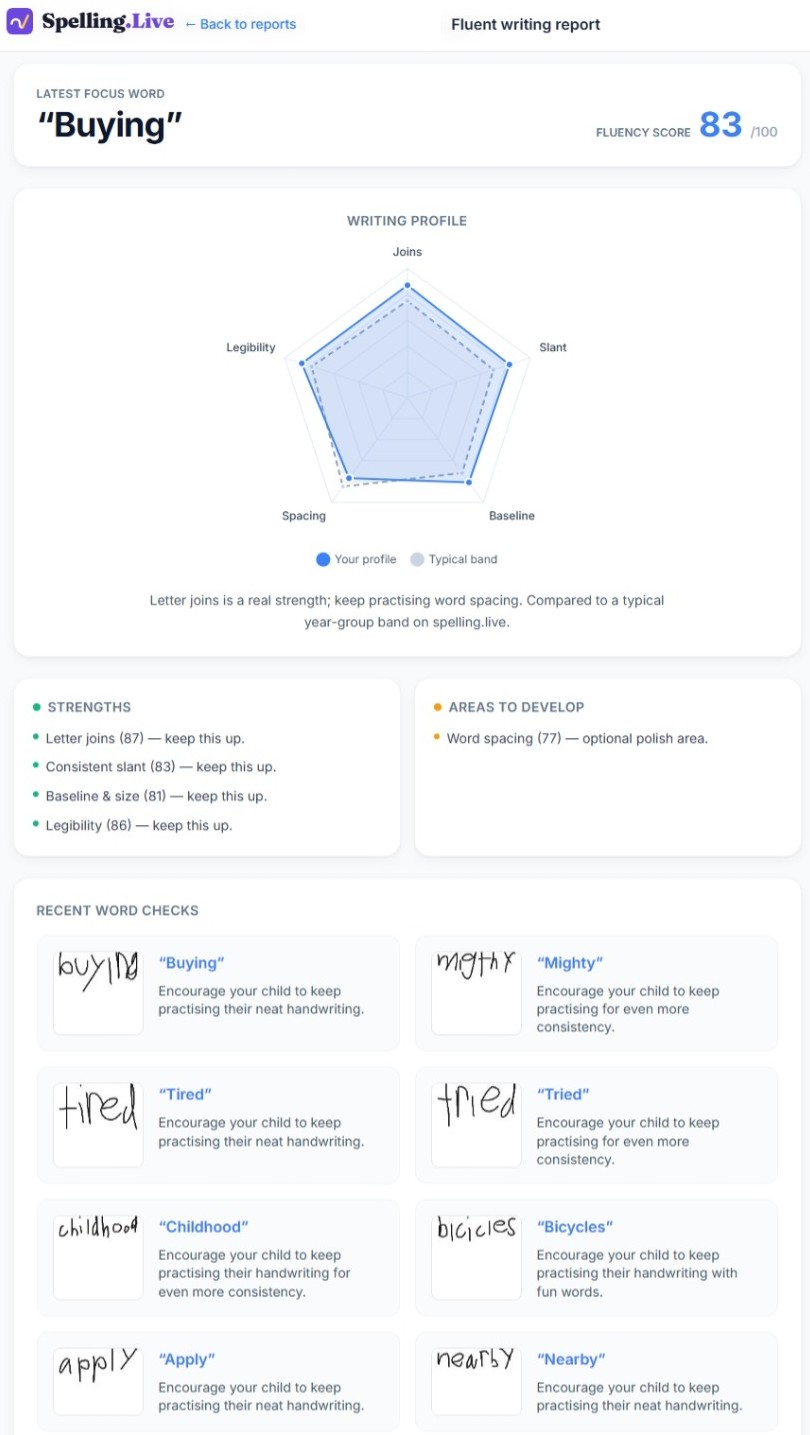
When pupils write their words on screen with Write it, the handwriting itself is scored as well as the spelling. This Class B pupil's writing report gives a fluency score of 83 out of 100:
| Writing skill | Score | Note |
|---|---|---|
| Letter joins | 87 | Strength |
| Legibility | 86 | Strength |
| Consistent slant | 83 | Strength |
| Baseline and size | 81 | Strength |
| Word spacing | 77 | Area to develop |
Underneath are the pupil's own handwritten words (buying, tired, tried, childhood, apply, nearby, and more), each with a line of feedback. Spelling and handwriting are kept as two separate reports. A word can be spelled right and still show a handwriting point, or be neatly written and spelled wrong. Mixing the two would hide both.
What this changes for a teacher
Without these reports, each class's week ends with a pile of test sheets to mark. With them, the teachers know:
- Who is practising. All 18 in Class B, 15 of 19 in Class A, and on how many different days.
- Which rule to teach. "ie" and "ei" for Class A, and double letters for both classes.
- Who has finished the list, and who has barely started, before the due date rather than after it.
- How each child's handwriting is developing, with their own writing on screen.
None of it took any marking.
Try it with one class
We're offering a free one-class pilot this term: teacher access with 500 AI credits a month, help setting up your class and lists, and a direct line to me. Request a pilot on the For Schools page, or read how schools are using Spelling.Live first.