🎈 Balloon Pop
Pop the balloon with the correct spelling. Early years · free.

Every game on Spelling.Live uses the words your child is currently practising - not random vocabulary. Three games are free from the very first session; the rest unlock with coins earned from spelling practice, so there is always something new to work towards - and a reason to keep practising.
Pop the balloon with the correct spelling. Early years · free.
Neon cards fly past - tap the correct spelling. Fluent · free.
3D endless runner - dash through the correct next letter. Fluent · free.
Pills sit still - tap the correct spellings, leave the misspellings. Both bands · free.
Find every list word hidden in a letter grid. Unlock with coins.
Drag list words onto a Scrabble-style board to connect them. Unlock with coins.
Spin each letter drum until the word clicks into place. Unlock with coins.
Spin rotating rings to dial in every letter. Unlock with coins.
Whack the letters in the right order as moles pop up. Unlock with coins.
Solve a crossword built from their own spelling list. Unlock with coins.
Climb girders to grab the right letters, dodging barrels. Unlock with coins.
Steer through a maze collecting letters, dodging ghosts. Unlock with coins.
Trace connected letters to find as many words as you can. Unlock with coins.
Words float up the screen as colourful balloons. Children pop the balloon with the correct spelling - wrong spellings float harmlessly past. The faster they respond, the higher the streak bonus.
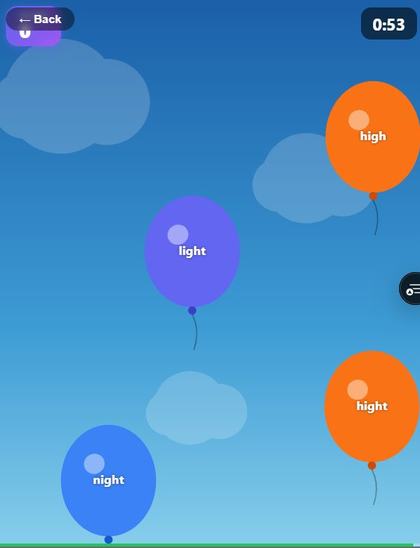
Rapid visual recognition - seeing the correct spelling instantly without sounding it out letter by letter.
Repetition through play. Children see their tricky words dozens of times per session without it feeling like drilling.
Only the words they are currently learning. Words they find hardest appear more often.
Play alongside them. Saying the word out loud as it pops reinforces the audio–visual link.
The fluent-band sibling of Balloon Pop: spelling cards fly past in neon colour instead of balloons. Children tap the card with the correct spelling before it flies off screen. Same instant, arcade-paced recognition, restyled for older children.
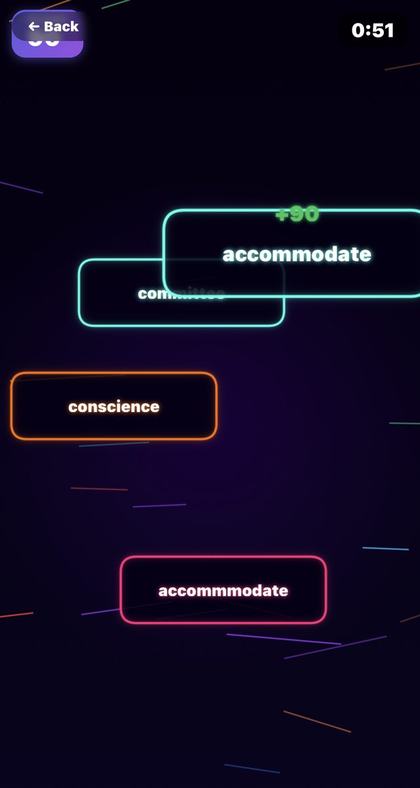
Visual discrimination under time pressure - spotting the one correct spelling among near-misses.
Children learn to spot the difference between near-identical spellings (accommodate / accommmodate) quickly and confidently.
Their current list and any words flagged as tricky. Wrong cards are generated from common misspelling patterns.
After a session, ask which word tripped them up. One word, discussed briefly, is often enough to fix it.
A full 3D endless runner. Your child's own avatar sprints down a three-lane track collecting the target word one letter at a time - move left/right to line up the correct next letter, jumping and sliding past obstacles along the way. Spell a word cleanly and the run keeps going, faster each time.
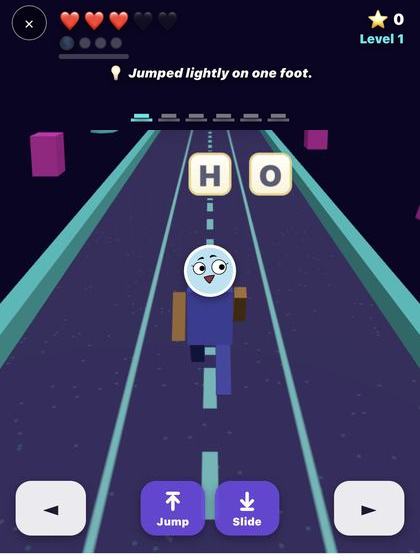
Letter-by-letter recall under momentum - deciding the next correct letter in a split second, rather than recognising a whole word at rest.
The wrong-letter "traps" in each lane are mined from your child's own real misspellings, so the dodge is always steering away from their actual error and toward the correct letter pattern.
Their current list, streamed continuously for an endless run - the longer they last, the more words appear.
Great for children who freeze up on a whole word - it breaks spelling into one small decision at a time.
The reading-first sibling of Balloon Pop: nothing moves. Pills carrying correct spellings and misspellings from their own list sit still on the board, and the child taps the correct ones and leaves the misspellings alone. Five lives, lost only to a wrong tap - never to the clock. A wrong tap lights up the right spelling, says the word aloud and buzzes the phone, so every mistake teaches. Clean rounds build a streak that levels the game up, with a new backdrop each level and Shield, Freeze, Heart and Star power-ups to earn.
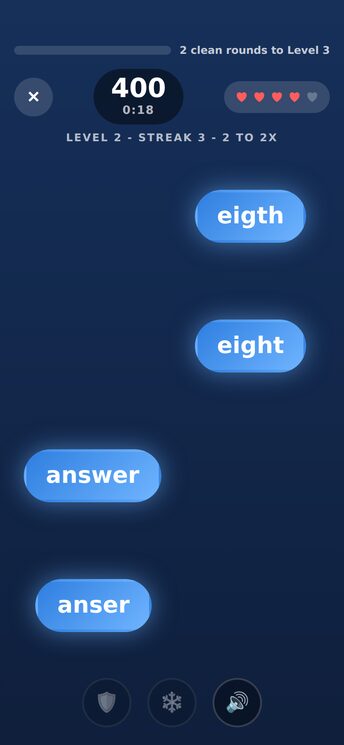
Telling a correct spelling from a near-miss by reading, with no time pressure on the early band.
Children who can spell the words but cannot catch a moving balloon get the same game at their own pace. The early band shows the word's picture when they get one right.
Their current list, with the wrong answers drawn from real misspellings - never a correct word.
Challenge a friend from the results screen - they play the identical rounds, so it is a fair contest.
A letter grid filled with their current word list - hidden horizontally, vertically, and diagonally. Children find and highlight each word. A calm, focused activity that works well as a wind-down after an active session.
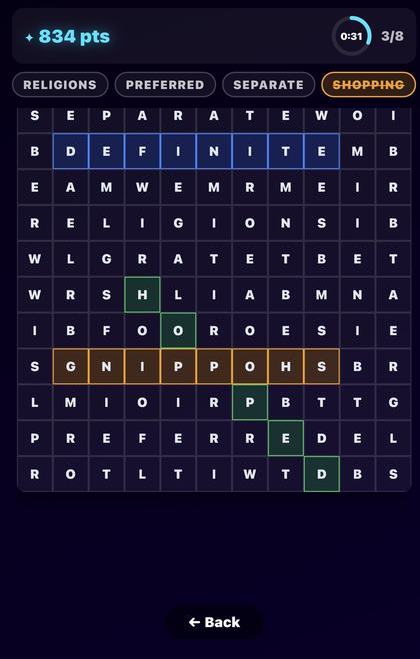
Letter-pattern recognition and careful scanning - children must hold the full spelling in mind while searching.
Slower and more deliberate than Balloon Pop or Spell Buzz. Suits children who benefit from a lower-pressure format.
All words in the active list. Longer words are especially valuable here - the grid makes full letter sequences visible.
Good for evenings when energy is low. Five minutes of Word Search counts as genuine practice.
Every word in their current list appears as a ready-spelled tile strip in a tray. Children drag each one onto a Scrabble-style board - rotating it horizontal or vertical - so it crosses and connects with the words already placed, like building a personal crossword. Landing on a bonus square scores extra points.
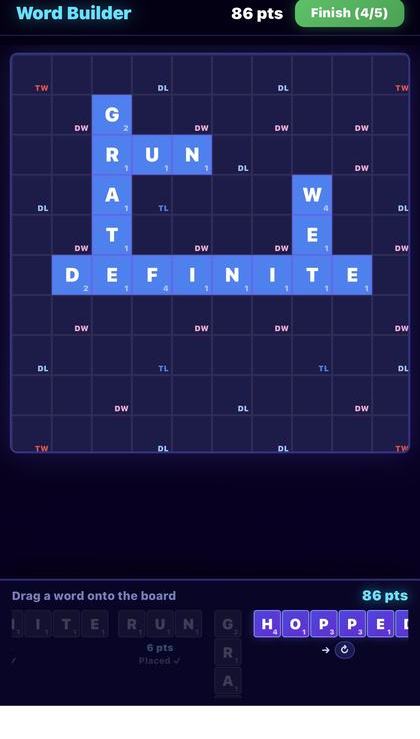
Spotting where two of their own words share a letter so they interlock correctly - a close look at the exact letters and positions inside each word.
Seeing several spelling words laid out together, letter by letter, reinforces the precise sequence of each one - useful once a word is recognised but not yet automatic to write.
Every word in the current list gets a tile - a full round places them all onto one connected board.
If they struggle to find where two words connect, spell both out loud together and spot the shared letter.
Every letter of the hidden word sits on its own spinning drum. Children dial each drum up or down through a run of decoy letters until it shows the right one, racing a clock - with speed and streak bonuses for fast, consecutive solves.
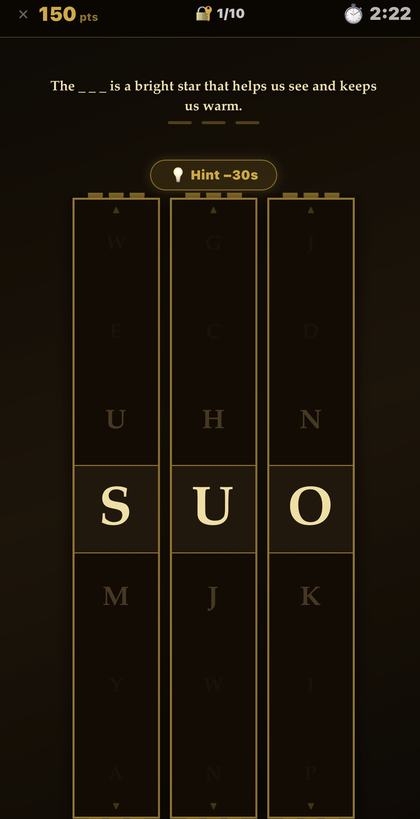
Letter-by-letter recall against the clock, plus reading a clue (a friendly meaning for early years, a crossword-style clue for fluent) to work out the word before dialling.
Combines meaning and spelling in one go - useful for words a child recognises by sound but hasn't fully locked in visually.
Their current list. Higher practice multiplier than most games, since every letter is actively recalled.
If a particular drum takes several tries, that letter position is worth a quick handwriting check.
Word Lock's sibling, themed as concentric spinning rings instead of drums. Children select a ring and rotate it until the correct letter lines up at the marker, filling in the word before time runs out.
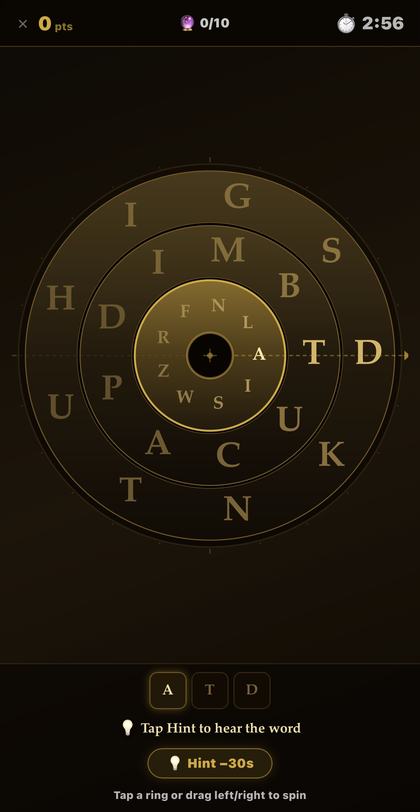
Active letter-by-letter recall against the clock, with the same clue-first approach as Word Lock.
A visually different take on the same skill - useful variety for children who tire of one game format.
Their current list, with the same higher practice multiplier as Word Lock.
Offer Ring as the "next" game once Word Lock feels repetitive - the mechanic transfers instantly.
Moles pop up out of their holes holding letters. Children whack them in the correct order to spell the target word - whacking the wrong letter costs a life, and the round ends when lives run out or time expires.
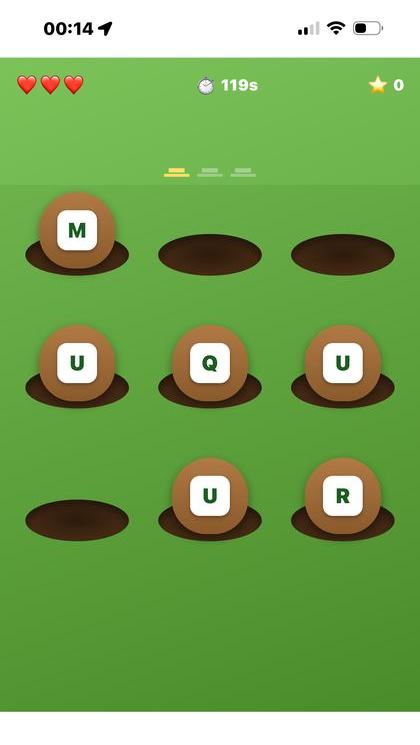
Letter-sequence recall under reflex pressure - knowing which letter comes next, fast.
A high-energy, physical alternative for children who find calmer games like Word Search too slow.
Their current list, with difficulty and mole speed tuned to age band.
Good short-burst game between longer practice sessions - rounds are quick and satisfying.
A crossword grid built entirely from their own spelling list, with an AI-written clue for every word that never gives the spelling away. Children tap a clue, then type the answer on the on-screen keyboard.
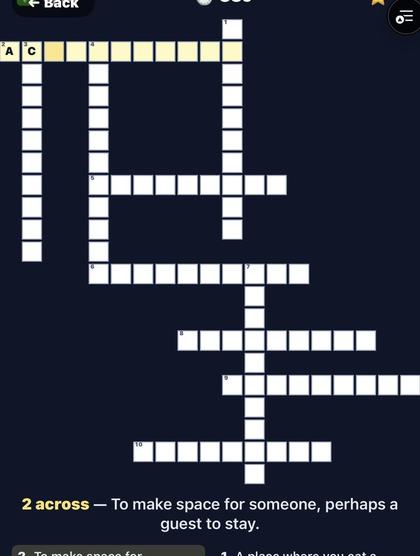
Spelling from meaning, not from sight of the word - closer to how spelling is tested at school.
Reinforces the meaning of a word alongside its spelling, which is a strong combination for retention.
Every word in their current list gets a clue - a full round covers the whole list.
If a clue stumps them, that is often a word they can spell but do not yet fully understand.
A Donkey-Kong-style platformer. The word appears with some letters blanked out, and letter tiles - correct ones and decoys - are scattered across girders. Children climb ladders to grab the right letters while dodging thrown barrels.
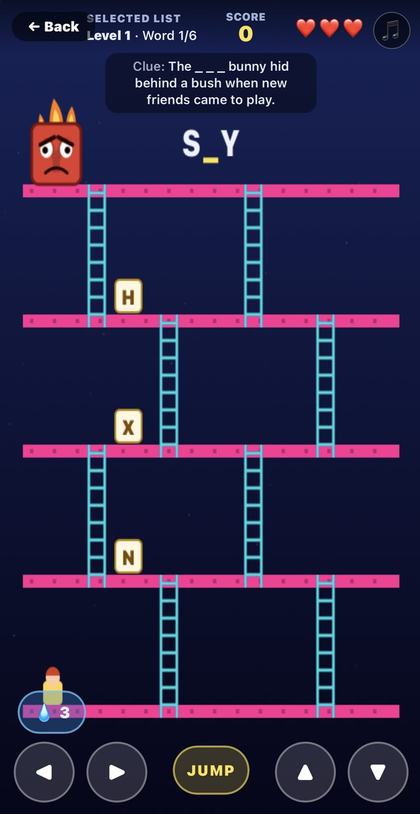
Picking the correct missing letter from distractors while navigating - recognition plus recall together.
The arcade framing (ladders, barrels, three lives) makes repeated attempts at a tricky word feel like a game, not a retest.
Their current list, with distractor count and speed scaled to age band.
Watch which letter they hesitate over on the girders - that is usually the letter worth practising next.
A Pac-Man-style chase. The word appears with blanked letters, and children steer through a maze collecting the letters they need while ghosts give chase - a power pill in the corner briefly lets them turn the tables.
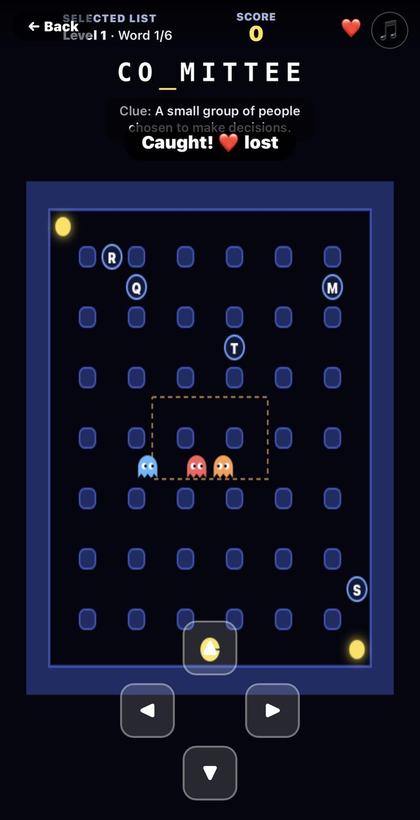
Holding a partly-completed spelling in mind while navigating and reacting - working memory under pressure.
A different pressure profile from Letter Climb - chase-and-evade rather than climb-and-dodge, so it suits different children.
Their current list, with maze complexity and ghost speed scaled to age band.
If they keep getting "caught" on the same word, it is worth a slower look at that word outside the game.
A classic 4×4 letter grid. Children trace a finger across touching letters - across, down, or diagonally - to spell as many valid words as they can before time runs out. Words from their spelling list score a big bonus.
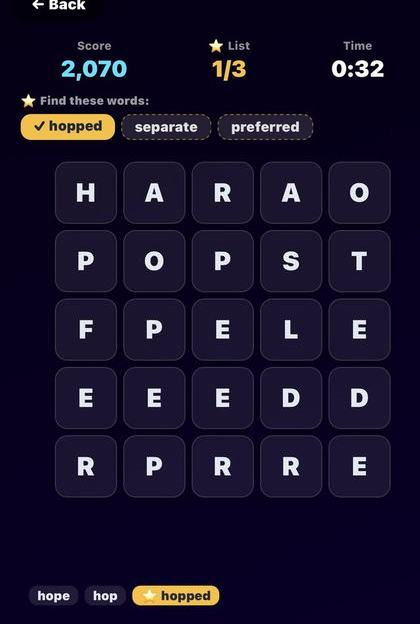
Broader word fluency and letter-pattern spotting, on top of the specific spelling list words worth bonus points.
Open-ended, so confident spellers can push themselves beyond the assigned list while still being rewarded for hitting it.
Any valid word scores, but their current list words are flagged and worth extra - the most plays of any game per unlock (10).
Good for older siblings or a parent to play alongside - the open word-finding format suits mixed abilities.
After completing almost any game, share a challenge link - via WhatsApp, text, or any app. The recipient plays the exact same words (and, for board-based games, the exact same layout) and sees how their score compares. Grandparents, siblings, classmates, and teachers can all join in.
The same words, with added motivation. Children tend to focus harder when someone else is going to see their score.
Learning spelling can feel solitary. The challenge link turns it into a shared moment - which is often what keeps the habit going.
Anyone with the link. They do not need a Spelling.Live account to accept a challenge.
Challenge them yourself. Losing to a parent is surprisingly motivating for children who find practice tedious.
A My Challenges pill sits under the Games heading on the child's home screen once a challenge is out, showing who has played it and their score. Nobody played yet? Tap 🔗 Share link right there to send the link again - no need to start a new challenge. Each challenge also shows when it expires (challenge links last 7 days).
Balloon Pop (early years), Spell Buzz / Spell Sprint (fluent) and Spell Blitz (both) are always free - start playing as soon as words are loaded, no coins needed.
Every correct word in practice pays coins. The games themselves don't pay coins, so practice is the only way to earn them - a good five-word session earns roughly enough to unlock a cheaper game.
Spend coins to unlock a game for a set number of plays - anywhere from 200 to 460 coins depending on the game, for 3 to 10 plays. Word-heavy games like Word Search and Boggle come with more plays; quick arcade games like Letter Climb and Letter Maze come with fewer.
When a game's plays are used up it locks again, and a little more practice unlocks another batch - keeping the focus on spelling. You can tune each game's coin price and play count any time from your parental controls (Game prices & plays).