
Drafted with AI assistance and reviewed, fact-checked and edited by hand before publishing - see our AI transparency page for how we use AI across the app.
In September, New South Wales announced daily limits on screen use in its public schools, starting at up to 15 minutes a day for Kindergarten to Year 2, with guidelines recommending at least an hour a day of learning with pen and paper. In November, Australia's education ministers agreed to work towards the Year 5 NAPLAN writing test being done with pen and paper from 2028.
As NSW Education Minister Prue Car put it to the ABC: "We want to make sure that at school it's not the default, that the default is pen and paper."
For spelling, that is the right default. A child learns a spelling by writing it, so the writing belongs on paper. What a screen does better is everything after the writing: reading what the child wrote, working out why a word went wrong, and deciding what to practise next. Spelling.Live is built around that split:
- Write on paperThe child spells from memory with a pencil. The app can read the words aloud, so they never need to look at it.
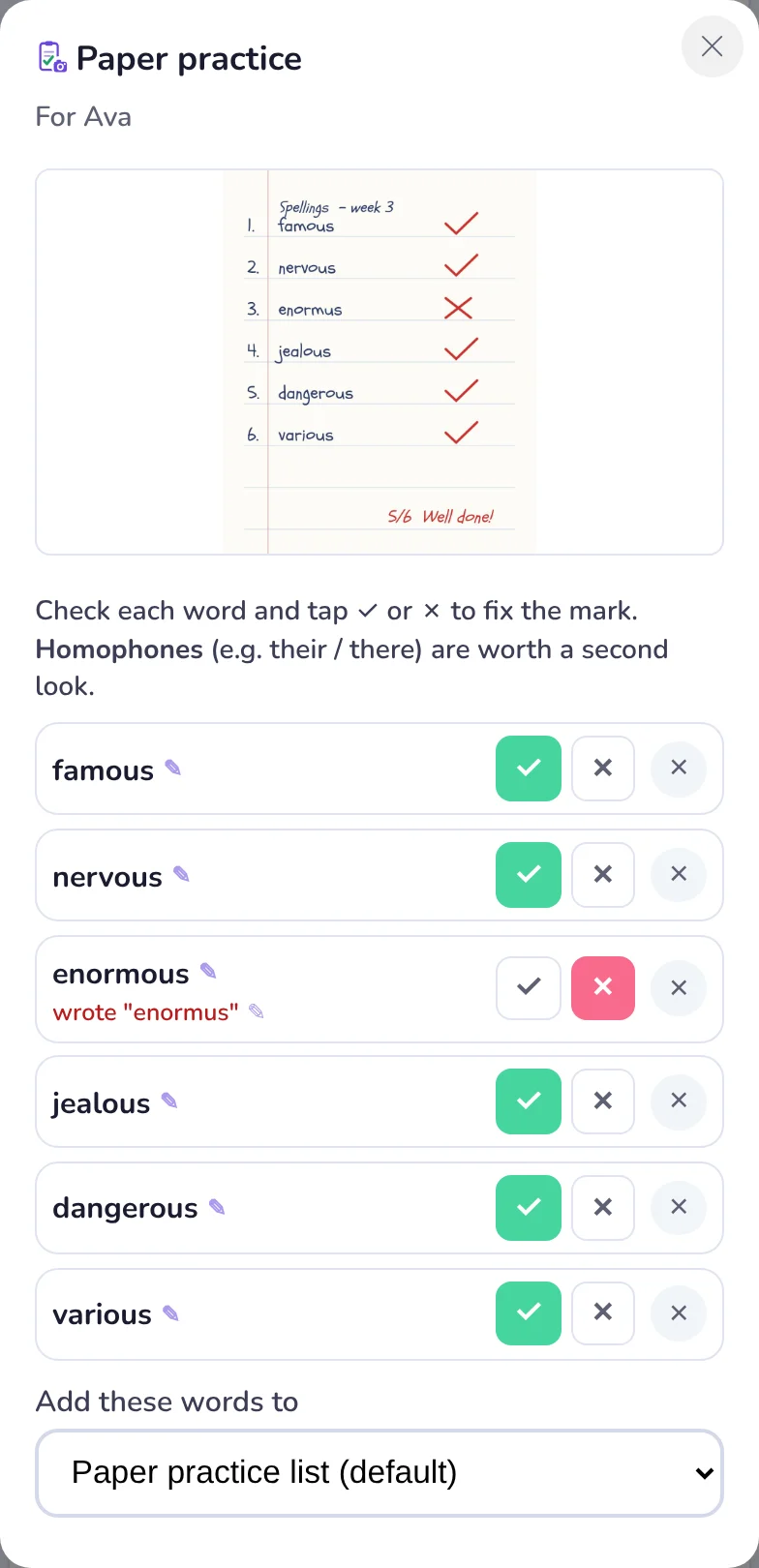
- Capture the resultA grown-up photographs the page. The app reads the handwriting and marks every word.
- Understand the mistakesEach wrong word is matched to the spelling rule behind it, such as the "-ous" ending.
- Practise what mattersMissed words come back sooner, and next week's practice starts with them.
The child holds the pencil. The grown-up holds the phone.
The rest of this post covers what was announced, how each step works at home and in class, and how it lines up with the Australian Curriculum.
What has been announced
In NSW public schools, recommended from Day 1, Term 1 2027 and mandatory from 2028:
- Screen-use limits on laptops, tablets and desktop computers: up to 15 minutes a day for Kindergarten to Year 2, 30 minutes for Years 3 and 4, 45 minutes for Years 5 and 6, then up to a quarter of the time in each subject for Years 7 to 10 and half for Years 11 and 12. These are maximums, measured across a week of lessons.
- No individual student device use in public preschools.
- At least one hour a day of learning using pen and paper.
- Less screen time for homework, with devices for homework not recommended before Year 5.
- Exemptions for students with disability or additional needs, students for whom English is not their first language, and where digital support is part of a personalised learning plan.
Across Australia, agreed by education ministers in November 2026:
- The Year 5 NAPLAN writing test to return to pen and paper, working towards 2028. Year 3 already writes on paper. ACARA, which writes the Australian Curriculum and runs NAPLAN, will advise on Years 7 and 9.
- An Australian Schools Digital Detox Taskforce, with ministers surveying parents, students and teachers as they consider further reforms.
Why this matters for spelling
Spelling is one of the ten criteria the NAPLAN writing test is marked on, judged on accuracy and on how difficult the words are. On paper, every one of those words is spelled by hand. A child who can pick the right spelling from a list, or type it with a keyboard's help, has not necessarily practised writing it from memory.
Prue Car made the same link: a pen-and-paper assessment "will then necessitate more classroom time being pen and paper as opposed to a computer." For the research on handwriting and memory, see our post on Sweden bringing back handwriting.
How the four steps work at home
1. Write on paper
Any of these will do:
- A Dictation test. Tap the headphones button on your child's card and the app reads each word aloud, with a sentence, while they write on numbered paper. The sentence is what tells their from there. See how the Dictation test works.
- A printed practice pack. One tap prints a week of pages built from your child's own words: look-cover-write-check, a crossword or word search, a short paragraph and a Friday test with a fold-under strip for the grown-up. Printing is free. See what is in the pack.
- The school's own test. If a marked spelling test comes home, that counts too.
- A paper week. The learning plan's Paper-First Week puts written practice on Monday and Thursday and a paper test on Friday. On a paper day, the app asks your child to fetch a grown-up. See the learning plan.
If your child needs to use a screen, as the NSW exemptions allow, the Write it pad keeps the practice handwritten, with dyslexia-friendly settings if they help.
2. Capture the result
Photograph the page. The app reads your child's handwriting, or the ticks and crosses on a marked test, marks each word and asks you to check anything it is unsure about. For a paragraph, there is no photo: open Paper writing on your child's card and tick which spelling words they used, and whether each was right.
3. Understand the mistakes
A score shows how many words went wrong; the pattern shows why. "enormus" is filed under the "-ous" ending ("famous", "dangerous", "nervous"), and the progress report groups tricky words under the rule behind them, so three wrong words can turn out to be one thing to learn. Naming the pattern behind a spelling mistake explains how.
4. Practise what matters
The app keeps track of every missed word and brings it back sooner, on a spaced schedule, until it sticks. The next printed pack starts with the words that are due, and the weekly plan adds them to practice sessions. See how tricky words stick.
In the classroom: the same four steps for a class
- Write on paper. Print a numbered sheet with a QR code for each student to write on, and a teacher's script with each word in a sentence.
- Capture the result. Photograph the sheets with a phone or tablet, or upload one scanned PDF, then check any answers the app flags.
- Understand the mistakes. The class report groups mistakes by spelling rule, so you can see that half the class is mixing up "-tion" and "-sion" instead of reading thirty separate scores.
- Practise what matters. Print a personalised practice pack for every student in one run, each starting with the words that student needs to see again. A cold and hot test week tests this week's list and last week's on paper on Monday, with both scores side by side.
See the step-by-step class test walkthrough. Teacher accounts get free class tools, with student logins that need no email address, and schools and tuition centres can apply for a free pilot.
How Spelling.Live lines up with the Australian Curriculum
Set your child to Australian English and the app accepts Australian (British-style) spellings, reads words in an Australian voice, names school years Foundation to Year 6 and offers ready-made lists for each year level.
The progress report is organised under the Australian Curriculum (version 9), using its English content descriptions word for word, with their codes. Those describe spelling in a few broad lines a year, so under each one we list the specific rules that put it into practice. Under AC9E3LY11, for example, are the "ou" in young, the "ch" in chemist and the "eigh" in eight, each marked Started, Nearly there or Secure.
This is where the four steps connect to the curriculum. A rule only reads Secure when your child has spelled it right, unaided and in writing, on different words. A dictation test, a paper test or a paragraph counts; picking a spelling from a list does not. One spelling map, four countries explains how the Australian version was built.
Ministers have also agreed to merge ACARA into a new Teaching and Learning Commission. Nothing announced so far changes the version 9 English content descriptions; if that changes, we will update the report.
What we are not claiming
- Spelling.Live is made by AK Shah Ltd, a small company in England, and is not affiliated with or endorsed by the NSW Department of Education, ACARA or any Australian government.
- The NSW limits apply to NSW public schools, and the Year 5 NAPLAN change is something ministers are working towards for 2028. Details may change.
- Prices are in pounds sterling, and your bank converts them to Australian dollars.
Working together in Australia
Families in Australia already use Spelling.Live, and we would like to work with the people who support them. If you are a teacher, tutor, tutoring centre or literacy specialist, we will set you up, walk you through it and listen to what would make it fit your classroom. If you supply resources to Australian schools or families, as a reseller or distributor, and think there is a fit, we would be glad to talk.
Email support@spelling.live with "Australia" in the subject line. Schools can also request a quote or read Spelling.Live for schools.
Frequently asked questions
Can my child use Spelling.Live without looking at a screen? For a lot of it, yes. In a Dictation test the app reads the words aloud and your child writes them on paper. The printed practice pack is paper from start to finish. A grown-up uses a phone, tablet or computer to start the test, print the pages and photograph the sheet, so the screen is in the adult's hand rather than the child's.
Does Spelling.Live follow the Australian Curriculum? Yes. For a child set to Australian English, the progress report is organised under the Australian Curriculum (version 9) English content descriptions for Foundation to Year 6, word for word with their codes. Under each one are the specific spelling rules that put it into practice, each marked Started, Nearly there or Secure.
Will Spelling.Live help with the Year 5 NAPLAN writing test on paper? It helps with the spelling side of it: spelling words by hand, from dictation and in your child's own sentences. Spelling is one of the ten criteria the NAPLAN writing test is marked on. Spelling.Live does not practise or mark the writing task itself.
What does paper practice cost? Printing the practice pack is free, and so is marking a paragraph. Marking a test from a photo uses 10 credits (up to 15 words). Every account starts with 200 free credits and no card, and on a Family or One-child plan a covered child's practice is included. Prices are in pounds sterling. See all prices.
Does Spelling.Live work with schools, tutors or resellers in Australia? We would like to. Teachers can set up a free class account today. If you are a school, tutor, tutoring centre, literacy specialist or an organisation that supplies resources to Australian schools or families and you think there is a fit, email support@spelling.live with Australia in the subject line.
Sources
- NSW Department of Education, Screentime limits in public schools to lift our game in the classroom, 13 September 2026.
- ABC News, NSW public schools set for new screen time limits under government guidelines, 13 September 2026.
- NSW Government, New South Wales leads push for return to pen and paper NAPLAN writing tests, 1 November 2026.
- ABC News, Digital backlash sees NAPLAN writing test return to pen and paper for year 5 students from 2028, 3 November 2026.
- ABC News, Ministers agree to huge school system shake-up and antisemitism plan, 5 November 2026.
- ACARA, NAPLAN narrative writing marking guide, for the ten marking criteria.
Australian Curriculum content descriptions © Australian Curriculum, Assessment and Reporting Authority (ACARA) 2010 to present, unless otherwise indicated, licensed under CC BY 4.0. The spelling rules Spelling.Live lists under each one are our own.
Try it with this week's list
Set your child to Australian English, add the list that came home, and try a Dictation test this week. It is free to start with 200 credits and no card. Start on the Australian page or see how it works.